
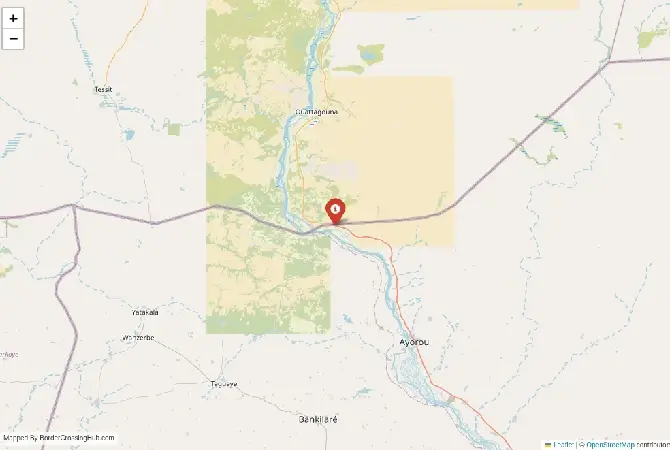
Monthly Update (September 2026):
Ayorou & Gao region remains a highly insecure Niger-Mali frontier area and should not be treated as a normal international road crossing. The wider Sahel region continues to face serious militant and kidnapping risks, while Niger itself experienced renewed military unrest at the end of August. No significant September reopening or traveler-friendly change has been identified. For overland travelers, the security situation is the overriding consideration rather than border processing times.
About this crossing
The route is sometimes referred to as the Ayorou Border on the Nigerien side and the Gao Region Crossing on the Malian side. In practice, it functions more as a controlled and sensitive frontier than a predictable transit point.
A river boundary shaped by history and conflict
The Niger River has long served as a natural boundary in this part of the Sahel. Communities along its banks have traded and interacted for centuries, particularly among Songhai and Tuareg groups.
Nearby Border Crossings





During colonial times, the river became part of the dividing line between French-administered territories. Today, while cultural ties remain strong, the region has been heavily affected by armed groups, military operations, and shifting control.
Gao, once a key trading city in Mali, sits within a region that has seen repeated instability over the past decade. This directly impacts any possibility of safe or regular border crossings.
What the crossing looks like today
You should not expect a formal, functioning border post in the way you would find in more stable regions. On the Niger side, Ayorou is a small riverside town with limited administrative infrastructure.
On the Malian side, the Gao region is under varying levels of military presence. Movement is often restricted, and access for foreign travelers is tightly controlled or entirely prohibited depending on current conditions.
In many cases, there is no clearly defined point where you can complete immigration procedures for international travel.
Border procedures and legal realities
For most travelers, this crossing is effectively closed. Even if you hold valid visas for both countries, you are unlikely to be permitted to cross overland here.
Authorities in both Niger and Mali may restrict access to border مناطق due to security concerns. Attempting to cross without authorization can lead to detention or more serious consequences.
If you need to travel between Niger and Mali, you should plan alternative routes or consider air travel where available. Relying on this crossing is not advisable.
Transport and access to the area
Reaching Ayorou from within Niger is possible by road from Niamey, though conditions can vary. The journey follows the Niger River and passes through rural مناطق with limited services.
However, approaching the border itself may involve checkpoints and restrictions. You should be prepared for inspections and possible limits on how far you can travel.
On the Malian side, access to Gao is highly controlled. Roads in the region are affected by security الوضع, and overland travel is generally discouraged for foreigners.
Transport options are limited and unreliable, especially near the border.
Environmental and logistical challenges
Even without security concerns, the Sahel environment presents its own difficulties. High temperatures, limited infrastructure, and long distances between settlements can complicate travel.
During the rainy season, parts of the المنطقة may experience flooding, particularly along the river. In the dry season, heat and dust dominate.
Basic services such as fuel stations, medical facilities, and accommodation are sparse once you move away from larger towns.
Security risks and current situation
This region is considered high-risk due to the presence of armed groups and ongoing military operations. Kidnapping, banditry, and attacks on vehicles have been reported in broader border areas.
Governments and international organizations generally advise against all travel to the Gao region and border zones near Ayorou.
You should check official travel advisories before planning any trip near this area. Conditions can change quickly, and access that appears possible one week may be restricted the next.
Nearby مناطق and safer alternatives
While the border itself is not suitable for crossing, Ayorou can still be visited as part of travel within Niger, provided conditions allow. It offers views of the Niger River and a glimpse of rural Sahel الحياة.
However, you should not plan to continue into Mali from here. Safer crossings between Niger and Mali are limited overall, and many routes are affected by similar security concerns.
Air travel between capitals or major cities is often the only practical option for international movement in this region.
Cultural and regional context
Despite current challenges, the area around Ayorou and Gao has deep cultural roots. The Niger River has supported trade, fishing, and agriculture for generations.
You will encounter communities with shared languages and traditions on both sides of the border, reflecting a history that predates modern boundaries.
However, these cultural connections exist alongside present-day realities that make travel difficult and sometimes dangerous.
Practical advice before considering travel
You should not attempt to cross at Ayorou–Gao under normal circumstances. If your itinerary includes both Niger and Mali, plan routes that avoid border مناطق with known instability.
If you travel near Ayorou, inform yourself about current conditions, register with your embassy if possible, and avoid unnecessary movement toward the border.
Carry essential supplies, including water and communication tools, as services are limited.
Final note
A border defined by restrictions rather than movement
The Ayorou–Gao region crossing reflects the broader challenges facing parts of the Sahel. While historically connected by trade and culture, it is now shaped by security concerns that limit travel.
For most travelers, this is not a viable crossing. Understanding its context is useful, but practical travel plans should focus on safer and more reliable routes.
View all border crossings between Niger and MaliPractical information
Currency
XOF,XOF informal
Safety information
River zone, light checks
Connectivity
Roads, boats
Have you crossed here?
Help other travelers by sharing your experience, wait times, and any updates.