Monthly Update (September 2026):
Astara remains an important Azerbaijan-Iran border checkpoint, but the practical situation for ordinary foreign travelers is highly restricted. Azerbaijan continues to require special permission for foreigners entering through land borders, while current travel guidance says the Azerbaijan-Iran land border is closed to ordinary arrivals and that Astara crossings can change at short notice. Azerbaijan's customs service still lists Astara as an international 24-hour checkpoint handling passenger and truck traffic, illustrating the difference between the checkpoint's customs status and actual tourist access. Travelers should obtain explicit confirmation before attempting an overland crossing.
About this crossing
Operational Details
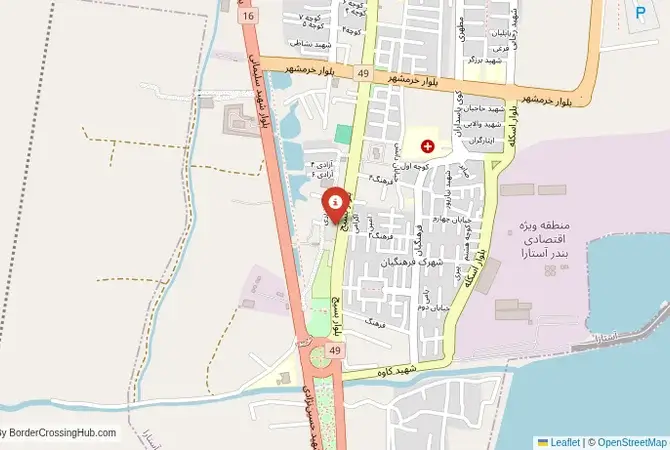
This checkpoint connects the Astara District of Azerbaijan with the Gilan Province of Iran. It is a major international crossing, open to passenger cars, buses, and commercial freight, though passenger access from Azerbaijan side remains restricted under current land border policies (extended through early 2026), with freight continuing under permissions. The facility is located directly in the city centers, which can lead to significant congestion. It is the primary coastal route for goods moving between Iran and Russia via Azerbaijan, and for tourists and pilgrims who travel between the two countries when conditions allow. The crossing can be very busy, with queues for trucks being a common feature, though recent agreements aim to boost daily truck movements to 350–400 vehicles and reduce congestion via coordinated measures and new handling capacities.
A History of a Divided Land
The history of this region is the history of the Talysh people, an Iranian ethnic group who have inhabited this coastal region for centuries. For a long time, the area was part of various Persian empires. The modern border was established by the Treaty of Turkmenchay in 1828, which divided the Talysh homeland between the Russian and Persian Empires. The Astarachay River became the new frontier, and the city of Astara was split in two. After the collapse of the Soviet Union, the crossing became a key point of interaction between independent Azerbaijan and Iran, a place of both significant trade and political sensitivity.
Nearby Border Crossings

Border Crossing Procedure
The border crossing procedure is a complex and often very slow process, reflecting the security concerns of both nations. You will first complete exit formalities at one country's checkpoint and then proceed across the bridge to the other country's checkpoint for entry inspection. You will need a valid passport and a visa for Iran (which must be obtained in advance for most nationalities). A "Carnet de Passages en Douane" is typically required for taking your own vehicle into Iran. The customs procedures, particularly on the Iranian side, are very thorough and can take many hours. Be prepared for detailed inspections of your vehicle and luggage. Patience and a calm demeanor are essential.
The Surrounding Region: Azerbaijan Side
On the Azerbaijani side, Astara is a pleasant subtropical resort town on the Caspian Sea. It is known for its beautiful beaches, its tea plantations, and its unique local cuisine. The nearby Hirkan National Park, a UNESCO World Heritage site, protects the unique relict forests of the Talysh Mountains, a haven of biodiversity. The city of Lankaran, the main center of the Talysh culture in Azerbaijan, is also a short drive away.
The Surrounding Region: Iran Side
On the Iranian side, Astara is a major port and a bustling bazaar town. It is a popular destination for shoppers from Azerbaijan. The crossing is the gateway to the beautiful Gilan Province of Iran, known for its lush, subtropical climate, its rice paddies, and its unique cuisine. The road from the border is a scenic coastal highway that leads towards the major cities of Rasht and the Caspian coast resorts. The beautiful mountain village of Masuleh, with its unique tiered architecture, is also in this region.
Practical Travel Information
Practical planning is absolutely essential for this route. You must have all your documents, including visas and carnet, in perfect order. The official currencies are the Azerbaijani Manat (AZN) in Azerbaijan and the Iranian Rial (IRR) in Iran. Currency exchange facilities are available, with better rates often in town markets away from the immediate border area. Ensure your vehicle's Green Card insurance is valid, though you will likely need to purchase separate insurance for Iran. Be aware of the strict laws and customs of the Islamic Republic of Iran, including the dress code for women. The urban location of the crossing means that services are readily available.
Final Considerations
The Astara–Astara border crossing is a journey through the heart of a divided city and a unique cultural region. It is a busy, functional checkpoint that serves as a vital link for the two sides of the Caspian coast. It offers a passage through a region of great natural beauty, from the relict forests of Hirkan to the tea plantations of Gilan. For the adventurous and well-prepared traveler, it is an unforgettable experience, a passage between two fascinating cultures. It is a border that is a testament to the resilience of the local communities and a poignant reminder of the complex history of the Talysh people.
View all border crossings between Azerbaijan and IranPractical information
Fuel
Azerbaijan: 500 m - Iran: 500 m
Currency
Exchange nearby; AZN, IRR
Safety information
High volume
Connectivity
Wi-Fi, 4G/5G
Have you crossed here?
Help other travelers by sharing your experience, wait times, and any updates.