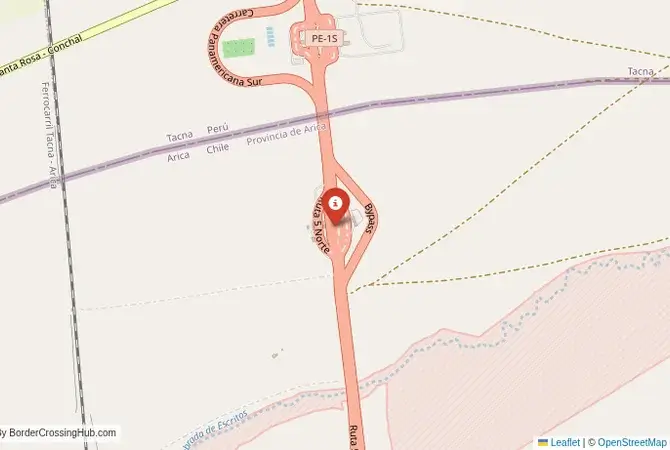
Monthly Update (September 2026):
Arica & Tacna remains one of the busiest pedestrian and road links between Chile and Peru, with the integrated Chacalluta-Santa Rosa system continuing to handle the border formalities. The 56-km Arica-Tacna journey can normally take around one to one and a half hours, but border processing can extend the trip considerably when traffic builds. Recent Chilean enforcement operations around Chacalluta have also targeted migrant smuggling and irregular crossings, making it particularly important to use the official crossing.
Driving there, or sending a driver? Send them this guide.
For reports and websites
Cite this page
Border Crossing Hub (2026). Arica & Tacna Border Crossing. Updated September 2026. https://bordercrossinghub.com/arica-tacna-border-crossing/<a href="https://bordercrossinghub.com/arica-tacna-border-crossing/">Arica & Tacna Border Crossing (Border Crossing Hub)</a>Put this crossing's card on your website
Free. It updates on its own when our information changes.
<iframe data-bch-card src="https://bordercrossinghub.com/arica-tacna-border-crossing/?bch_view=card" width="100%" height="980" scrolling="no" style="border:0;max-width:480px;display:block" loading="lazy" title="Arica & Tacna border crossing information"></iframe>
<p style="font-size:12px;margin:4px 0 0">Crossing information: <a href="https://bordercrossinghub.com/arica-tacna-border-crossing/">Border Crossing Hub</a></p>
<script src="https://bordercrossinghub.com/?bch_embed_js=1" async></script>Paste it where you want the card. The last line (a script) only adjusts the height and can be left out.
About this crossing
Operational Details
This checkpoint connects the Arica y Parinacota Region of Chile with the Tacna Department of Peru. It is a major international crossing, open to all passenger cars, buses, and commercial freight. The crossing is an integrated checkpoint, known as the Chacalluta-Santa Rosa complex, with both Chilean and Peruvian officials housed in large, modern facilities on both sides of the border line. This streamlines the process, as travelers can complete all formalities in a relatively organized sequence. It is one of the busiest land borders in South America, with a constant flow of people crossing for tourism, shopping, and, most notably, medical and dental services.
A History of the War of the Pacific
The history of this crossing is the history of the War of the Pacific (1879-1883), a conflict that profoundly reshaped the map of South America. Chile defeated a Bolivian-Peruvian alliance and annexed large territories, including the regions of Arica and Tarapacá from Peru, and the entire coastline of Bolivia, leaving that country landlocked. The city of Arica became part of Chile, while Tacna remained with Peru after a plebiscite. The border drawn here is a direct consequence of that war. For over a century, the relationship was tense. The modern, cooperative management of this border is a symbol of the new, peaceful relationship between the two nations.
Nearby Border Crossings



Border Crossing Procedure
The border crossing procedure is a well-organized but often very crowded process. You will first complete exit formalities at one country's checkpoint and then proceed to the other country's checkpoint for entry inspection. You will need a valid passport or, for citizens of some South American countries, a national ID card. Vehicle registration and international insurance (SOAT for Peru) are also necessary. A key part of the process is the strict agricultural inspection by Chilean authorities (SAG), who prohibit the entry of most fresh fruits, vegetables, and animal products. The queues can be very long, especially for the many "colectivo" taxis that ferry people between the two cities.
The Surrounding Region: Chile Side
On the Chilean side, the city of Arica is known as the "City of Eternal Spring" for its pleasant climate. It is a popular beach resort and a major surfing destination. The city's main landmark is the "Morro de Arica," a large cliff that was the site of a major battle during the War of the Pacific and now offers panoramic views. The San Marcos Cathedral was designed by the famous French architect, Gustave Eiffel. The nearby Azapa Valley is home to the San Miguel de Azapa Archaeological Museum, which houses some of the world's oldest mummies, the Chinchorro mummies.
The Surrounding Region: Peru Side
On the Peruvian side, the city of Tacna is a bustling commercial center. It is famous as a destination for "medical tourism," with thousands of Chileans crossing the border every day to take advantage of the much cheaper, high-quality dental and medical services available in the city. The city has a beautiful central plaza with a monumental arch and a decorative fountain. It is known as the "Heroic City" for its role in the struggle for Peruvian independence. The region is known for its production of pisco and olives.
Practical Travel Information
Practical planning for this route is straightforward. The Pan-American Highway is well-maintained. The official currencies are the Chilean Peso (CLP) in Chile and the Peruvian Sol (PEN) in Peru. Currency exchange facilities are widely available. The easiest way to cross for a day trip is by using the frequent and cheap "colectivo" taxis that run between the two city centers. Be prepared for long waits, especially on weekends. Remember the strict agricultural controls when entering Chile. Recent reports from 2025–2026 note occasional migration-related restrictions and militarization in the area, but the crossing remains open 24/7 with no major seasonal impacts.
Final Considerations
The Arica–Tacna border crossing is a journey through a landscape of desert beauty and deep history. It is a bustling, modern gateway that is a powerful symbol of the peaceful and pragmatic relationship between Chile and Peru. It is a border that is defined by the constant, daily movement of people seeking better prices, medical care, or simply a day out in a neighboring country. It is a fascinating example of how a once-hostile frontier can be transformed into a zone of intense and mutually beneficial cooperation.
View all border crossings between Chile and PeruHeading to Arica & Tacna? Take this with you.
One page with the hours, waits, emergency numbers and coordinates. Works without signal.
Practical information
Fuel
Chile: 500 m - Peru: 500 m
Currency
Available in Arica and Tacna (CLP, PEN, USD)
Safety information
Coastal highway; petty theft and queues
Connectivity
Basic 3G coverage
Have you crossed here?
Help other travelers by sharing your experience, wait times, and any updates.