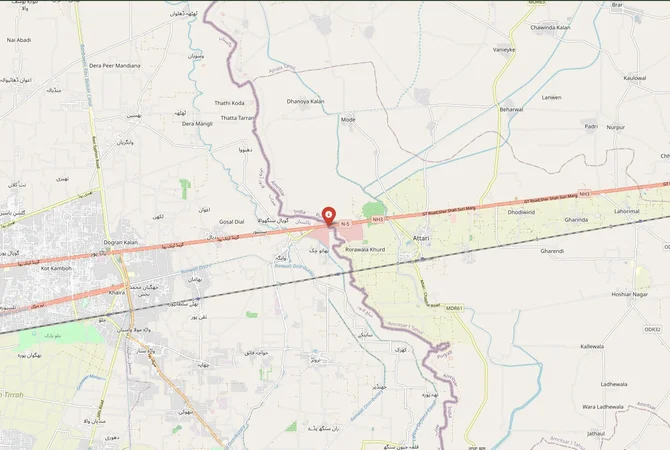
Monthly Update (September 2026):
Amritsar Lahore Border Crossing remains closed to normal travelers. Current UK government travel advice explicitly states that the Wagah-Attari crossing is closed and advises against travel within 10 km of the India-Pakistan border. India's Land Ports Authority continues to describe Attari as an important international land port, but that does not mean ordinary passenger crossing has resumed. There is no September reopening to report, so travelers should not plan a normal overland India-Pakistan journey through Wagah-Attari.
About this crossing
A Crossing That Requires Careful Planning
This border is not unsafe in terms of violence for travelers, but it is highly regulated and politically sensitive. You cannot arrive without proper visas and expect to cross. Both countries require visas issued in advance, and these visas are often city-specific. You should double-check that your visa explicitly allows entry or exit at the Attari–Wagah border. Without the correct endorsement, you will be denied crossing. Security is strict, and procedures can feel intense. Photography may be restricted in certain areas, and questioning by officials is normal.
Historical Context and Partition Legacy
The Amritsar–Lahore crossing carries deep historical weight. It sits near the line drawn during the 1947 partition of British India, which led to the creation of India and Pakistan. This event triggered one of the largest migrations in history, with millions crossing in both directions under difficult conditions. The border today reflects that legacy, with strong national symbolism on both sides. Despite political tensions, the crossing remains an important link for trade, diplomacy, and limited travel.
Nearby Border Crossings




Operating Hours and Daily Schedule
The border is generally open during daytime hours, typically from around 9:00 AM to 4:00 PM for crossing procedures. However, exact times can vary, and you should arrive early to allow enough processing time. Unlike many borders, this one does not operate late into the evening. Missing the cutoff time means waiting until the next day. In addition to standard operations, the border is famous for its daily closing ceremony, which takes place in the late afternoon.
Immigration Process Step by Step
On the Indian side, you will complete exit formalities at Attari. This includes passport checks, visa verification, and customs inspection. After exiting India, you will walk or take transport across a short stretch to the Pakistani side at Wagah. There, you will go through Pakistani immigration, where your documents are reviewed again. Entry procedures may include additional questioning, especially for foreign travelers. The entire process can take anywhere from one to three hours depending on queues and security checks.
Visa Requirements and Restrictions
Both India and Pakistan require visas for most travelers, and obtaining them can be a lengthy process. Important points to note:
- Visas must be arranged in advance; there is no visa on arrival
- Your visa must specify Attari–Wagah as a valid crossing point
- Some visas restrict which cities you can visit
- You may need to register with local authorities after arrival in Pakistan
You should plan your itinerary carefully to align with your visa conditions.
The Route Between Amritsar and Lahore
The distance between Amritsar and Lahore is only about 50 kilometers. Despite this short distance, crossing the border can take several hours due to formalities. Road conditions on both sides are good. Once you complete immigration, you can find taxis, buses, or pre-arranged transport to continue your journey. Lahore is about 30 kilometers from the border, while Amritsar is roughly the same distance on the Indian side.
The Wagah Border Ceremony
One of the most distinctive aspects of this crossing is the daily Wagah border ceremony. Held every evening before sunset, it features coordinated military drills, flag lowering, and large crowds on both sides. You can attend the ceremony as a spectator, but you should arrive early to secure a good spot. The event draws significant attention and can lead to increased congestion near the border. While it is separate from the crossing process, it adds to the unique atmosphere of the location.
Transport Options and Practical Logistics
From Amritsar, you can reach the border by taxi, auto-rickshaw, or local bus. The journey usually takes about 45 minutes. On the Pakistani side, transport options from Wagah to Lahore include taxis and private vehicles. Public transport is less common directly from the border, so arranging a ride in advance is advisable. There is also a cross-border bus service between Amritsar and Lahore, but it operates on limited schedules and requires prior booking.
Common Issues Travelers Face
Travelers often encounter a few recurring challenges at this crossing. These include:
- Visa complications or incorrect endorsements
- Long waiting times during peak periods
- Strict baggage inspections
- Limited communication if you do not speak local languages
You should keep printed copies of your documents and allow extra time for unexpected delays.
Cultural and Political Significance
This crossing represents more than just a travel route. It reflects the complex relationship between India and Pakistan, shaped by history, politics, and shared cultural roots. Despite tensions, the border remains a place where limited interaction continues through trade and controlled travel. The proximity of Amritsar and Lahore, both major cultural centers of the Punjab region, highlights the deep connections that exist across the border.
Nearby Attractions Worth Visiting
On the Indian side, Amritsar is home to the Golden Temple, one of the most important Sikh religious sites. The city also features historical landmarks related to India’s independence movement. On the Pakistani side, Lahore offers Mughal-era architecture, vibrant markets, and cultural institutions. It is one of Pakistan’s most historically rich cities. These destinations make the crossing particularly appealing for travelers interested in history and culture.
Final Thoughts
The Amritsar–Lahore border crossing is one of the most significant land routes between India and Pakistan, shaped by strict regulations and deep historical context. You should prepare thoroughly, ensure your visa is in order, and allow plenty of time for the process. While the crossing can be demanding, it offers a rare opportunity to move between two closely connected yet politically distinct regions.
View all border crossings between India and PakistanPractical information
Fuel
India: <1 km - Pakistan: <1 km
Currency
INR/PKR
Safety information
Secure
Connectivity
Good
Have you crossed here?
Help other travelers by sharing your experience, wait times, and any updates.