Monthly Update (October 2026):
Ak-Tilek & Karasu remains an operating Kyrgyzstan-Kazakhstan crossing and continues to provide an alternative to the much busier Korday-Ak-Jol gateway. Kazakhstan's current system lists Karasu-Ak-Tilek among its active checkpoints, making it a useful option for traffic around the Chu Valley, although travelers should check the day's operating schedule before setting out.
About this crossing
A History of Decongestion and Economic Integration
The history of this crossing is a direct response to the success and subsequent congestion of the main Korday-Ak-Jol border. As trade between Kyrgyzstan and Kazakhstan boomed after the fall of the Soviet Union, and especially after both joined the Eurasian Economic Union (EAEU), the Korday crossing became overwhelmed. The mix of pedestrians, cars, buses, and massive freight trucks created enormous bottlenecks, with wait times stretching for many hours or even days. The situation was inefficient for commerce and frustrating for travelers. In a joint effort, the Kyrgyz and Kazakh governments invested heavily in creating a dedicated freight corridor. They chose the Ak-Tilek-Karasu location and built a massive, modern complex with extensive customs yards, inspection bays, and administrative buildings specifically designed to process commercial cargo. The opening of this crossing was a major step in rationalizing the border, allowing the Korday post to focus on passengers and making the entire Bishkek-Almaty corridor more efficient. It is a border born of modern logistical necessity.
Border Procedures: For Trucks Only
This border crossing is not intended for use by pedestrians or private passenger cars. Signage on the highways leading to the border area directs all passenger traffic to the Korday-Ak-Jol crossing. Any car or pedestrian arriving at Ak-Tilek would be politely but firmly redirected to the correct crossing a few kilometers away. The procedures at Ak-Tilek-Karasu are entirely geared towards commercial freight. The Process for Commercial Freight: A truck driver arriving at the border enters a complex and multi-layered process.1. Queuing and Staging: Trucks are often marshaled in large staging areas to await their turn.2. Document Control: The driver must present a full manifest of their cargo, transport licenses, and customs declarations for both countries. This paperwork is extensive.3. Customs Inspection: The truck and its cargo are subject to a thorough inspection. This can include being weighed, having the container seals checked, and undergoing an X-ray scan by a massive drive-through scanner. In some cases, the cargo may be partially or fully unloaded for physical inspection.4. Phytosanitary and Veterinary Control: If the cargo is agricultural produce or livestock, it must be cleared by separate government agencies responsible for health and safety standards.5. Passport Control: The driver must also clear immigration personally. This entire process is extremely time-consuming and bureaucratic, which is precisely why this traffic has been separated from passenger vehicles.
Nearby Border Crossings


Route and Location in the Chu Valley
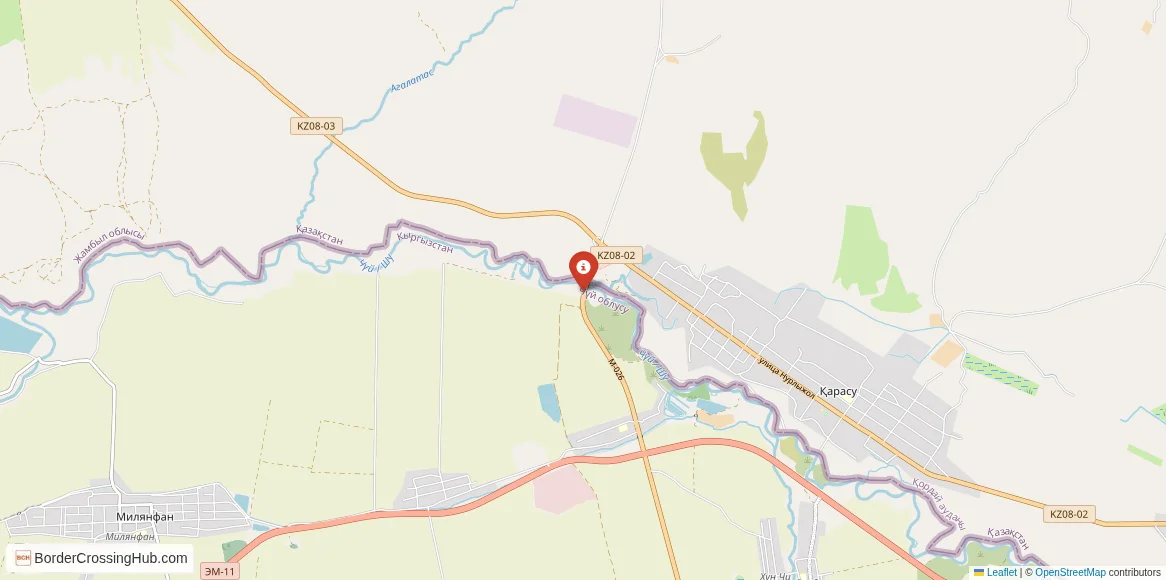
The Ak-Tilek-Karasu crossing is located in the Chu Valley, on the same plain as the Korday crossing. It is accessed by a separate spur road that branches off the main Bishkek-Almaty highway. The infrastructure around the border is massive, with large warehouses, logistics parks, and customs brokerage offices dominating the landscape. For a traveler on the main highway, the only sign of this crossing might be the sight of a long line of trucks waiting on the access road. The existence of this specialized crossing is a key piece of information for understanding the local geography. If you are driving and see signs for "Freight" or "Trucks," you know you are on the wrong path and should follow the signs for "Passenger Cars" or "Korday" to reach the correct border post.
Final Contextual Note: A Border of Business
The Ak-Tilek-Karasu crossing is a vital piece of Central Asia's economic infrastructure, but it is not a part of the tourist experience. It is a border of business, a place where the real, tangible goods that underpin the relationship between Kyrgyzstan and Kazakhstan are processed. Its existence is a huge benefit to the ordinary traveler, as it makes the journey through the main Korday-Ak-Jol crossing much faster and more pleasant than it would otherwise be. It serves as a powerful reminder that international borders have many functions, and that facilitating the movement of people is only one of them. For the overland traveler, Ak-Tilek-Karasu is a place to be aware of but not to visit, a silent partner that makes your own journey across the nearby passenger border possible.
View all border crossings between Kyrgyzstan and KazakhstanPractical information
Fuel
Kyrgyzstan: <1 km - Kazakhstan: <1 km
Currency
Exchange in Ak-Tilek (KGS, KZT)
Safety information
Generally safe, queues
Connectivity
Wi-Fi points, 4G
Have you crossed here?
Help other travelers by sharing your experience, wait times, and any updates.