
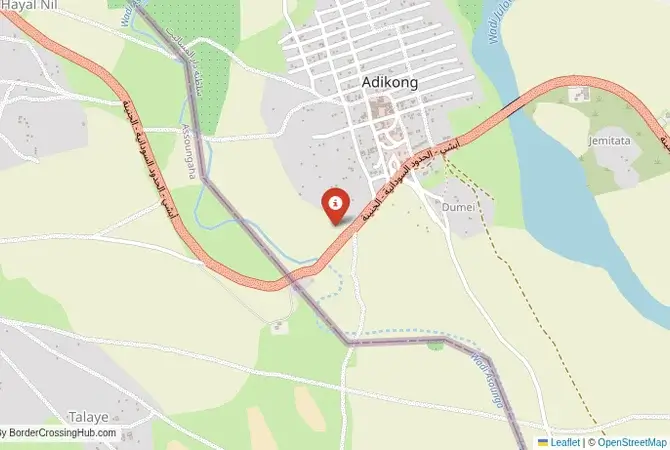
Approximate Border Location
Wait Times
30–90 min typical
Just crossed? Tap to report:
Operating Hours
Open 7:00 AM–5:00 PM
Crossing Types
Pedestrians, vehicles
Border Type
Land crossing via road
Peak Times
7:00–10:00 AM, weekends
Daily Crossings
1,900–2,100 crossings
Currency Exchange
Exchange near Genena (SDG, XAF)
Safety Information
Restricted, security risks
Languages Spoken
Arabic, French, English
Accessibility Features
Ramps, assistance
About Adré & Genena
Monthly Update (March 2026):
As of 03/2026, the Adré & Genena Border Crossing between Sudan and Chad sees steady movement with trucks, buses, and traders crossing the desert route. Customs inspections can slow the truck side a little. Midday tends to bring the biggest rush. Regional trade drives the activity.
No Cell Service at the Border? No Problem.
Don’t get caught scrambling for paperwork when you lose signal. Download the complete Africa Transit Guide directly to your device and access every critical detail, fast-track strategy, and border rule – 100% offline.
Important Note: An Active War Zone and Humanitarian Catastrophe
The border between Sudan and Chad at Genena-Adré is at the absolute epicenter of the humanitarian catastrophe caused by the war in the Darfur region of Sudan. It is an active and extremely dangerous conflict zone. The crossing has been the primary escape route for hundreds of thousands of refugees fleeing horrific ethnic violence and is the main corridor for humanitarian aid. It is not a border crossing for travelers. It is a place of immense human suffering and profound insecurity. This guide is for geopolitical and humanitarian context only. Attempting to travel to this region is impossible and would be suicidal.
The Genena-Adré Crossing: The Darfur Escape Route
The border crossing that connects the city of Genena (Al-Junaynah), the capital of West Darfur in Sudan, with the town of Adré in Chad is the most significant gateway on this long and porous desert frontier. This is not a formal, paved highway crossing. It is a dusty, chaotic, and often desperate passage through the semi-arid Sahelian landscape. For two decades, this border has been defined by the conflict in Darfur. It has been a route for refugees fleeing violence, a sanctuary for rebel groups, and a corridor for weapons and smuggled goods. In the current Sudanese civil war, which has seen a horrific resurgence of ethnic cleansing in Darfur, the Genena-Adré crossing has become the single most important escape route for people fleeing for their lives. The atmosphere is one of crisis, a massive, sprawling humanitarian emergency, where international aid agencies struggle to cope with a relentless flow of traumatized and destitute people. The air is thick with the dust of countless footsteps and the weight of immeasurable loss, a place where the horizon offers not promise, but merely the hope of survival. As of late 2025 into 2026, new influxes continue, with thousands arriving monthly amid ongoing attacks in Darfur, including near El Fasher, overwhelming facilities and prompting urgent relocations to inland camps.
A History of a Porous and Conflict-Ridden Frontier
The history of this border is the history of the peoples of the Sahel, particularly the Masalit and Zaghawa ethnic groups, whose traditional lands straddle the modern political line. The border, drawn by French and British colonial powers, has always been a porous one, with nomadic groups moving freely with their herds in a way that defied the neat lines of European cartography. The outbreak of the Darfur conflict in the early 2000s transformed this frontier. The Sudanese government-backed Janjaweed militias launched a brutal campaign of violence against the non-Arab ethnic groups of Darfur. Hundreds of thousands of people fled across the border into Chad, creating massive refugee camps around the town of Adré. The conflict became cross-border, with Chadian and Sudanese rebel groups finding sanctuary and support on opposite sides of the frontier, and the two governments frequently accusing each other of interference. The recent outbreak of a new, even more brutal phase of the conflict in 2023 has repeated this tragic history on an even more catastrophic scale, with Genena being the scene of horrific massacres and Adré once again being overwhelmed by a massive influx of refugees. This is a border that has rarely known peace; its modern story is written in the language of displacement, violence, and survival. Chad now hosts over 1.2 million displaced from Sudan as of late 2025, with continued arrivals straining resources.
Border Procedures: A Humanitarian Corridor, Not a Border Crossing
In the current context, there are no “normal” border procedures. The concept of a formal crossing for travelers is non-existent. The border is a humanitarian corridor, managed by international aid agencies like the UNHCR and the Chadian military, in a desperate attempt to save lives.The Process for Refugees: People fleeing Genena, often after walking for days and witnessing horrific atrocities, arrive at the Chadian border in a state of exhaustion and trauma. They are registered by humanitarian agencies and directed to the sprawling refugee camps that have been set up around Adré. The process is not one of immigration, but of humanitarian registration and assistance, providing emergency food, water, and shelter. The focus is on saving lives, not on checking documents.For any other traveler, the border is a complete no-go zone. There are no facilities for processing visas or passports. The entire region is an active war zone. Any foreigner arriving in this area would be assumed to be a journalist, an aid worker, or a mercenary, and would be in extreme danger from all of the various armed groups operating in the region. Legal entry is impossible, and any attempt would be an act of extreme recklessness. Influxes persist into 2026, with recent movements including thousands through Adré amid persistent insecurity and risks like extortion along routes.
The Regional Context: The Sahelian Crisis
The crossing is located at the heart of the Sahel, a region beset by a complex crisis of climate change, poverty, and armed conflict. On the Sudanese side, West Darfur is one of the most dangerous places on earth. On the Chadian side, the Ouaddaï Region is also an impoverished and unstable area, and the massive influx of refugees has placed an unbearable strain on its limited resources, such as water and food. The entire border is a heavily militarized zone, with the presence of the Chadian army, various Sudanese armed factions, and international peacekeepers and aid workers. The infrastructure is almost non-existent. The roads are rough desert tracks, often impassable during the rainy season. Travel is extremely difficult and dangerous. This is one of the most challenging logistical environments in the world for humanitarian operations, a place where delivering aid is a constant battle against geography and insecurity. No significant infrastructure changes have occurred, and seasonal rains continue to exacerbate access issues.
Final Contextual Note: A Gateway of Suffering
The Genena-Adré border crossing is a place that represents one of the world’s worst ongoing humanitarian catastrophes. It is a symbol of the horrific human cost of the war in Sudan and the decades of conflict in Darfur. It is a border that is defined not by trade or tourism, but by flight, fear, and the desperate search for safety. For the outside world, it is a place to be understood through the work of humanitarian organizations and journalists who risk their lives to document the tragedy. It is a stark and powerful reminder of how a line on a map can become the difference between life and death for hundreds of thousands of people. It is a border that, for now, is a gateway of suffering, a testament to a crisis that the world must not forget.
No reviews yet.