
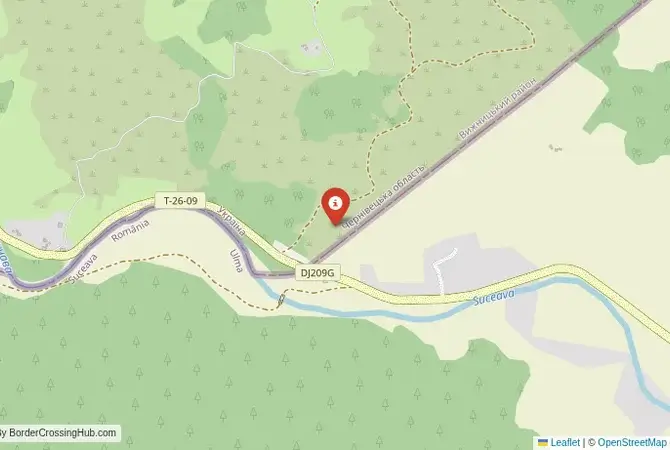
Approximate Border Location
Wait Times
15–60 min
Just crossed? Tap to report:
Operating Hours
6:00 AM–10:00 PM
Crossing Types
Pedestrians, vehicles
Border Type
Land crossing via road
Peak Times
7–10 AM
Daily Crossings
1,500–2,500 daily
Safety Information
Quiet rural area
Languages Spoken
Ukrainian/Romanian
Accessibility Features
Ramps, assistance
About Rus’ka & Ulma
Monthly Update (June 2026):
As of June 2026, the Rus’ka & Ulma Border Crossing has been quiet and mostly predictable. Local traffic ticks along without much buildup, though checks can slow things down when several cars arrive together. Rain and seasonal travel patterns are the biggest sources of variation.
A Closed, Remote Crossing
Important Note for Travelers: This border crossing is a simplified, local checkpoint that has been closed for many years and is not operational for international travel. This guide is provided for historical and informational purposes only. The border crossing that once connected the Ukrainian village of Ruska with Ulma in Romania is a journey into one of the most remote and inaccessible corners of the border. This was not an international checkpoint in the modern sense, but a “simplified crossing point” intended only for the local residents of the immediate border villages. It was a simple footbridge or a basic path, a way for people to cross the border to visit family or work on their lands without making an arduous journey of many hours to the nearest official checkpoint. It represents the most basic and fundamental form of a border crossing: a recognized point of passage for a local community.
Operational Details
This checkpoint connected Ukraine’s Chernivtsi Oblast with Romania’s Suceava County. Its operation was extremely limited. It was typically open only one or two days a week, for a few hours each day. It was strictly for pedestrians who were permanent residents of the designated border communes. No vehicles were allowed, and it was not open to tourists or citizens from other parts of the country. Its purpose was purely to facilitate local cross-border life, a pragmatic solution to the challenges of a border drawn through a sparsely populated, mountainous region.
A History of a Divided Land
The history of this region is the history of Bucovina, a crown land of the Austrian Empire that was a famously multicultural melting pot of Romanians, Ukrainians, Germans, Jews, and Poles. The border, established after World War II, divided this historically integrated region. For decades, the communities in this mountainous part of the border had no legal way to cross directly. The establishment of a simplified crossing point was a post-Cold War development, an agreement between Romania and Ukraine to ease the burdens on the local population, a small but significant step in humanizing the border.
Signal can be a coin toss at borders, and the last thing you want is to be stuck at the gate hunting for info. We’ve pulled all our research for this region into one simple eBook that works 100% offline. It keeps everything you need in one spot so you can stay focused on the trip. Grab the guide here.
Former Border Procedure
The border crossing procedure, when it was operational, was a very simple affair. Local residents, who were on an approved list, could approach the checkpoint during its limited opening hours. They would present their local identity documents to the Ukrainian and Romanian border guards stationed at either end of the crossing. The checks were focused on confirming identity and residency. It was a process based on community recognition rather than anonymous international travel protocols.
The Surrounding Region
The surrounding area is a beautiful, mountainous landscape of the Bukovinian Carpathians. On both the Ukrainian and Romanian sides, the region is characterized by dense forests, high pastures, and traditional mountain villages where a self-sufficient way of life has been preserved. This is one of the most remote and least-developed parts of the border. The nearest towns of any significance are many hours’ drive away. The appeal of the region lies in its pristine nature and its authentic, traditional culture.
Closure and Legacy
Simplified crossing points like Ruska-Ulma were suspended and closed as Romania prepared to join the European Union. The strict requirements of the Schengen acquis meant that all border points had to be upgraded to full international standards, and small, informal crossings like this one were no longer permissible. Furthermore, the ongoing war in Ukraine has led to a complete sealing of such remote border points. The path is now overgrown, and the border is secured against any unauthorized passage.
Final Considerations
The Ruska–Ulma border crossing is a ghost of a more informal and localized approach to border management. Its story is a fascinating glimpse into a time when special arrangements could be made to serve the needs of local communities living on a frontier. Its closure was an inevitable consequence of Romania’s EU integration and the modern emphasis on border security. It remains a poignant reminder of the human element of borders, of the simple need for a farmer to cross a river to reach his field, or for a grandmother to visit her grandchildren in the next village, even if that village is in another country.
No reviews yet.