Monthly Update (November 2026):
Long queues are again causing frustration at Beni Ansar–Melilla, particularly for vehicles entering Morocco. Reports from November 15 describe waits stretching well beyond an hour on some journeys, with slower passport checks on the Moroccan side contributing to the buildup. Morocco has also launched a project to modernize electrical and computer equipment at Beni Enzar, although that work has not yet reduced the delays. For travelers, the difference in processing speed between the two sides remains the most noticeable issue this month.
Driving there, or sending a driver? Send them this guide.
For reports and websites
Cite this page
Border Crossing Hub (2026). Beni Ansar & Melilla Border Crossing. Updated November 2026. https://bordercrossinghub.com/beni-ansar-melilla-beni-enzar-border-crossing/<a href="https://bordercrossinghub.com/beni-ansar-melilla-beni-enzar-border-crossing/">Beni Ansar & Melilla Border Crossing (Border Crossing Hub)</a>Put this crossing's card on your website
Free. It updates on its own when our information changes.
<iframe data-bch-card src="https://bordercrossinghub.com/beni-ansar-melilla-beni-enzar-border-crossing/?bch_view=card" width="100%" height="980" scrolling="no" style="border:0;max-width:480px;display:block" loading="lazy" title="Beni Ansar & Melilla border crossing information"></iframe>
<p style="font-size:12px;margin:4px 0 0">Crossing information: <a href="https://bordercrossinghub.com/beni-ansar-melilla-beni-enzar-border-crossing/">Border Crossing Hub</a></p>
<script src="https://bordercrossinghub.com/?bch_embed_js=1" async></script>Paste it where you want the card. The last line (a script) only adjusts the height and can be left out.
About this crossing
What to expect at the crossing
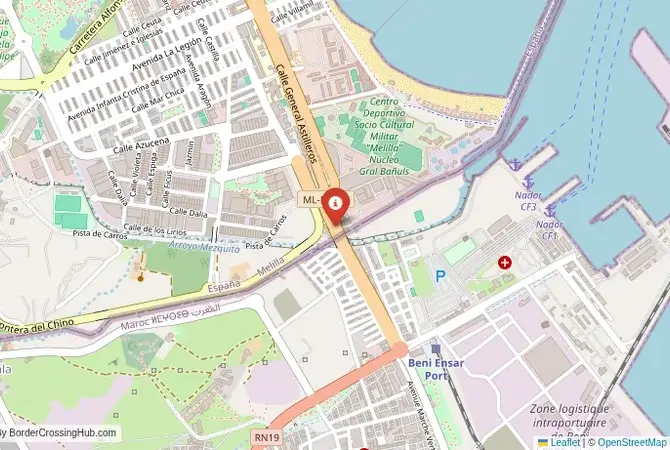
Beni Enzar is the only operating land crossing between Melilla and Morocco, so there is no alternative post to switch to when it is restricted.
That mattered at the end of July 2026. The crossing closed for nearly two days after an attempted mass entry and reopened on the morning of 1 August. Passage resumed gradually: cars that had been held up in the Operation Paso del Estrecho (OPE) summer flow went first, about 800 vehicles crossed by evening, and pedestrians were let through in organised groups of about twenty. The Government Delegation in Melilla said it would keep reviewing the situation.
Hours and waits
Opening hours are not officially published. Waits swing widely and are longest in summer, when the annual Operation Paso del Estrecho brings large numbers of Moroccans living abroad through the region. Vehicles are slower than pedestrians in both directions, so there is no typical wait to plan around.
How to cross
The post is a run of controls, with covered walkways between the Spanish and Moroccan sides, and the order depends on your direction. The post has been renovated in recent years, so the sequence below is the general pattern rather than a counter-by-counter map:
- Exit control in the country you are leaving. Going into Morocco, that is Spanish control first; going into Melilla, Moroccan control first.
- The walkway between the two posts. The line itself is easy to miss, and passing through the gate on the other side means you are in the other country.
- Entry control and customs in the country you are entering. Police and customs may ask about your plans, and on the Spanish side for proof of accommodation. Vehicles use separate lanes.
Documents and checks
For Spain, non-EU visitors need the documents that apply to the Schengen area, including a Schengen visa if their nationality requires one, and are registered in the EU Entry/Exit System. Passports should be valid for at least three months. Officers may ask for proof of accommodation and funds and for health insurance. Morocco usually asks visitors to fill in an entry card, and European national ID cards are generally not accepted there, only passports.
Melilla has a special Schengen regime. According to the Spanish foreign ministry, Schengen checks are made when leaving Melilla by sea or air, the only two routes, so entering Melilla is only the first of two filters before the mainland. Goods bought in Melilla are generally not allowed into Morocco under the traveller's regime.
If you drive, a car entering Morocco must be in the driver's name or covered by an official authorisation.
Onward travel
Melilla's port has ferries to Málaga, Almería and Motril, and the city has a small airport with flights to mainland cities such as Madrid and Málaga. Since there is no road to the mainland, these are the only routes onward to Spain.
On the Moroccan side, the crossing lies in the port town of Beni Ansar, about 12 km north of Nador, the nearest city. Beni Ansar's port is also known as Nador Port. Melilla itself, with about 87,000 residents, is served by six local bus lines, so the city centre is reachable without a car once you are through.
Trade across the line
Morocco closed its customs office near Melilla in 2018 without consulting Spain, and it was expected to reopen in January 2023. By February 2025 trade was still tentative and limited.
A short history
Melilla has been Spanish since it was occupied on 17 September 1497, and Morocco claims it. Most of its old buildings date from the early 20th century: it has the second-largest concentration of Modernista (Art Nouveau) works in Spain after Barcelona, mostly designed by the Catalan architect Enrique Nieto. The fortified land border is patrolled by Spain's Civil Guard.
Nearby Border Crossings

Heading to Beni Ansar & Melilla? Take this with you.
One page with the hours, waits, emergency numbers and coordinates. Works without signal.
Practical information
Fuel
Morocco: <1 km - Spain: <1 km
Currency
Available near Beni Ansar (MAD, EUR)
Safety information
Restricted, security risks
Connectivity
Wi-Fi at checkpoints, 4G
Have you crossed here?
Help other travelers by sharing your experience, wait times, and any updates.