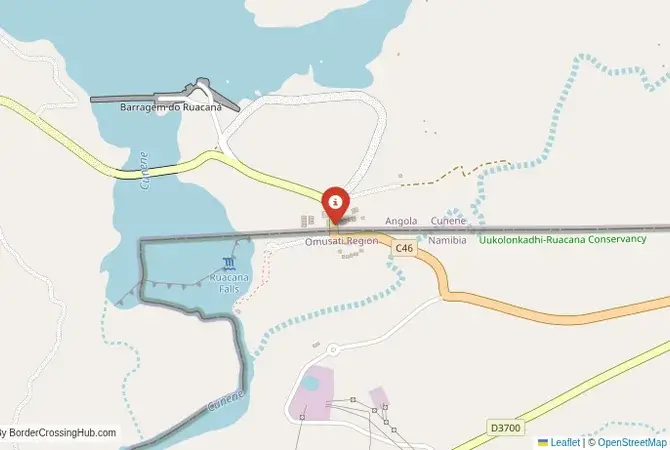
Monthly Update (September 2026):
Ruacana remains an active Namibia-Angola border crossing, with Namibia's immigration service currently listing gate hours of 08:00 to 18:00. The nearby Omahenene post operates until 19:00, but travelers should not confuse the two checkpoints when planning their arrival. There is no significant September closure reported, so the main practical point is to reach Ruacana well before its 18:00 closing time.
About this crossing
A History on a Contested River
The history of this border is the history of the Kunene River. The river has been a lifeline for the Himba and Herero people for centuries, a source of water in an arid land. The border is a colonial legacy, a line drawn between Portuguese West Africa and German South West Africa that cut through the traditional lands of these peoples. The Ruacana Falls became a point of major strategic and economic interest in the 20th century with the construction of the Ruacana hydroelectric power station, a joint project between the Portuguese and South African authorities. The project was highly controversial and became a major issue in the Namibian War of Independence. The border region was a major conflict zone, with South African forces based at Ruacana and SWAPO liberation fighters operating from bases in Angola. The end of the war in Namibia and the subsequent end of the civil war in Angola has brought peace to the region. The border crossing at Ruacana has been formalized, and it now serves as a key link for the Himba people, whose traditional lands straddle the frontier, and for the growing number of adventurous tourists exploring this remote corner of Africa. It is a border defined by the immense power of the river and the complex history of conflict and cooperation it has witnessed.
The Border Crossing Procedure: A Basic and Rustic Affair
This is a relatively quiet border, and the process is generally straightforward, but the facilities are basic. The border is open during daylight hours only, typically from 06:00 to 18:00. You must have your visas sorted in advance. Exiting Namibia (Ruacana): The Namibian immigration and customs post is a simple, functional building in the town of Ruacana. You will present your passport and get your exit stamp. The customs check for vehicles involves checking your road tax permit. The process is generally relaxed and quick due to the low volume of traffic. The No-Man's-Land: After clearing the Namibian post, you will drive a short distance to the Angolan side. The road takes you past the impressive dam and offers views of the falls (which are often dry due to the dam, but can be spectacular after heavy rains). Entering Angola (Ruacana): The Angolan post is also a basic facility. You must have a pre-arranged Angolan visa; recent updates allow visa-free entry for tourism stays up to 30 days for many nationalities, but confirm eligibility in advance as visas on arrival are not available at this crossing. You will present your passport and visa to the immigration officer. You will also need your yellow fever vaccination certificate. The customs process for a vehicle will be a manual, bureaucratic affair. You will need a temporary import permit for Angola. The officials may be less accustomed to tourists than at the main Oshikango crossing, so a degree of patience is required.
Nearby Border Crossings





Route, Onward Travel, and The Kaokoveld
This crossing is for the self-sufficient traveler with a 4x4 vehicle. On the Namibian side, the road to Ruacana from the main road network is paved and in good condition. The town of Ruacana is the gateway to the Kaokoveld, one of the last true wilderness areas in southern Africa, famous for its desert-adapted elephants and the traditional culture of the Himba people. On the Angolan side, the road from the border is a major challenge. It is a rough, unpaved track that leads north towards the city of Lubango. The journey is a long, slow, and arduous one, through a very remote and undeveloped part of Angola that is still recovering from the war. You must be completely self-sufficient with fuel, food, water, and vehicle recovery equipment. There is no public transport on this route. This is a true expedition, a journey into a land that sees almost no tourists. The rewards are immense, offering a glimpse into a part of Africa that feels truly untouched by the modern world.
Final Planning Advice for a Wilderness Route
The Ruacana crossing is a gateway to a serious overland adventure. It is not a border for the casual tourist but for the experienced and well-equipped explorer. The key to a successful crossing is meticulous planning. You must have your Angolan visa in your passport before you arrive (or confirm if visa-free entry applies) and be prepared for a multi-day, self-sufficient expedition on the Angolan side. The reward is a journey into a part of Africa that is truly off the map, a land of incredible beauty, rich culture, and profound wildness. It is a passage from the well-managed tourist routes of Namibia into the challenging but deeply rewarding world of post-war Angola. It is a border for the true adventurer, a step into one of the continent's last great wildernesses.
View all border crossings between Namibia and AngolaPractical information
Fuel
Namibia: <1 km - Angola: <1 km
Currency
Available near Ruacana (NAD, AOA)
Safety information
Generally safe, river risks
Connectivity
Wi-Fi at checkpoints, 4G
Have you crossed here?
Help other travelers by sharing your experience, wait times, and any updates.