Monthly Update (October 2026):
Goliševa & Opochka remains a minor Russia-Latvia frontier point rather than a practical alternative for ordinary international travelers. Latvia's active external-border controls continue to focus heavily on security and immigration screening, while the main Russia-Latvia passenger routes are subject to significant restrictions. There is no October development suggesting that this smaller crossing has become a normal tourist gateway.
About this crossing
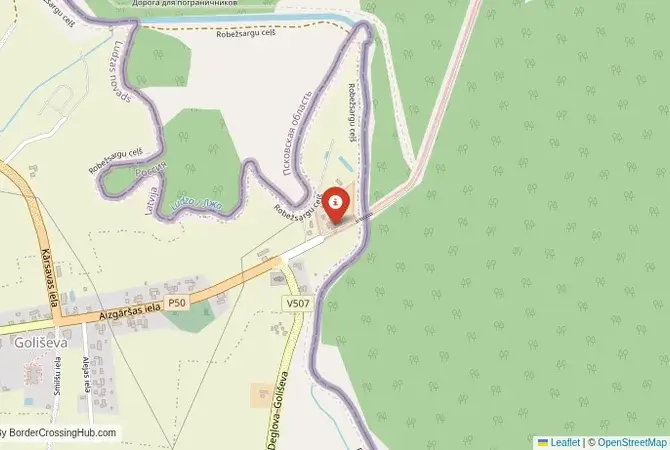
The Goliševa Crossing: A Rural Frontier Post
This border crossing is located in a deeply rural and sparsely populated part of the Russo-Latvian frontier. This is a landscape of forests, lakes, and small farming villages, the beautiful and quiet countryside of the Latgale region. The crossing itself is a small, simple post on a secondary road. It is not a highway for international trade but a local link, designed to serve the needs of the communities that were divided by the international border. The atmosphere is one of profound quiet and rural isolation. The traffic is minimal, consisting of a few local cars and perhaps a farm vehicle. For the traveler, this crossing is a point on the map that represents the deep, local texture of the border, a world away from the endless lines of trucks and the formal, impersonal nature of the major crossings. It is a border that feels connected to the land and the people who live on it.
A History of a Local Connection
The history of this border is one of local life. For centuries, this was a fluid frontier zone, a patchwork of estates and villages with mixed populations. The modern border, established after Latvian independence and re-established in 1991, cut through this quiet rural landscape. The closure or restriction of small crossings like this one after the collapse of the Soviet Union caused significant hardship for local people, who were suddenly cut off from relatives, graveyards, and markets that were only a few kilometers away. The formalization of the Goliševa crossing as a local, bilateral checkpoint was a pragmatic solution to this problem. It allows for a degree of managed, local movement, helping to sustain the cross-border community ties that are a legacy of a shared history. Its purpose is not to serve international transit, but to serve the human-scale needs of the borderland population. It is a border that is about community, not about commerce on a grand scale. Remains restricted to local/bilateral traffic only into 2026, no processing for third-country nationals.
Nearby Border Crossings


Border Procedures: Not Applicable for Most Tourists
As this is not a designated international crossing for all nationalities, the procedures for a typical foreign tourist are not applicable. The crossing's legal status is often "bilateral," meaning it is only for use by citizens of the two adjacent countries (Russia and Latvia).For a foreign traveler (e.g., an EU citizen who is not Latvian, or an American, etc.), attempting to use this crossing would likely result in being turned away. The border guards are not authorized to process third-country nationals. Their computer systems and the legal framework under which they operate are designated for bilateral traffic only. You would be politely, but firmly, redirected to one of the main international crossings at Grebņeva or Terehova, which would involve a long and frustrating detour. The Process for Authorized Locals: For the Latvian and Russian citizens who are permitted to cross here, the process would be a simplified version of the main border checks. They would present their passports, and the officials would stamp them in or out. The customs checks would be focused on preventing local smuggling of items like fuel and cigarettes, which are much cheaper in Russia.
The Regional Context: The Land of Blue Lakes
The crossing is located in the beautiful Latgale region of Latvia, an area famous for its hundreds of picturesque lakes. It is a popular destination for domestic tourism, for people seeking nature, peace, and quiet. On the Russian side, it is in the Pskov Oblast, a region rich in Russian history, with ancient fortresses and monasteries. The landscape on both sides is very similar: a gentle, rolling countryside of forests and water. The roads leading to this crossing are secondary, rural roads. They are paved but can be narrow and in poorer condition than the main highways. The infrastructure is very limited. This is not a region designed for transit. It is a destination in itself, a place to be explored slowly. The main international crossings are designed to get you from A to B. A crossing like Goliševa is about the life that exists at point C, the border itself.
Final Contextual Note: A Border to Be Aware Of, Not to Use
The Goliševa crossing is a fascinating example of a local, bilateral border. It serves a vital function for the people who live on the frontier, and it is a testament to the need for human-scale solutions in a world of hard international lines. However, for the international overland traveler, it is a non-option. It is a point on the map to be understood, not to be included in an itinerary. The risk of being turned away is almost 100%. Any travel plan between Russia and Latvia must be routed through the major, designated international gateways at Terehova or Grebņeva. These crossings are equipped and authorized to handle all nationalities and will provide a predictable, if sometimes slow, passage into the European Union. The quiet charm of the Goliševa crossing is best left to the local residents it is intended to serve.
View all border crossings between Russia and LatviaPractical information
Fuel
Russia: <1 km - Latvia: <1 km
Currency
Limited near Opochka (RUB, EUR)
Safety information
Generally safe, remote risks
Connectivity
Limited Wi-Fi, 3G
Have you crossed here?
Help other travelers by sharing your experience, wait times, and any updates.