Monthly Update (October 2026):
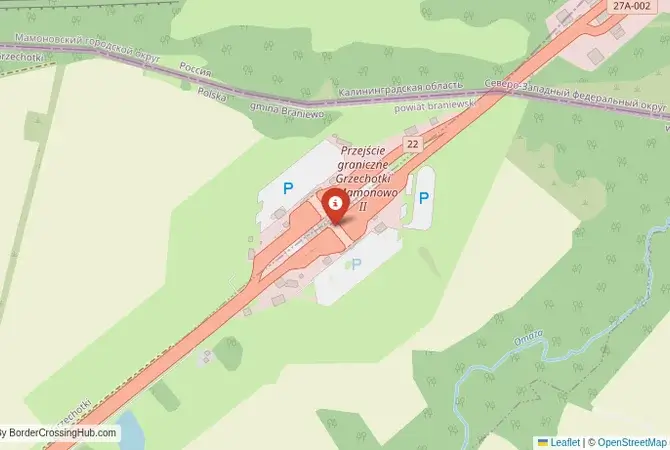
Braniewo & Kaliningrad Oblast is not a single active road crossing but covers the wider Braniewo-Kaliningrad frontier, where the active road options remain limited. The Braniewo-area crossings are operating under the current Russia-Poland restrictions, while the Gronowo-Mamonovo road post remains suspended. Travelers should use the currently functioning Grzechotki-Mamonovo II or Bezledy-Bagrationovsk routes rather than relying on older information about the smaller crossings.
About this crossing
A History on the Prussian Coast
The history of this border is the history of the Baltic coast of East Prussia. The entire region, including the great port city of Danzig (now Gdańsk), the area around Braniewo (formerly Braunsberg), and the town of Mamonovo (formerly Heiligenbeil), was a heartland of German culture and history for centuries. The Vistula Lagoon was a center for fishing, trade, and the unique culture of the Prussian coast. This world was shattered at the end of World War II. The border drawn at the Potsdam Conference, a line decided by the victorious Allied powers, cut directly through this historically unified region. The northern part of East Prussia, including its capital Königsberg, became the Soviet Kaliningrad Oblast. The southern part became part of Poland. The German population was forcibly expelled in a massive and traumatic act of ethnic cleansing, and the area was repopulated with Poles and Russians. During the Cold War, this was a heavily fortified and hermetically sealed frontier, a hard edge of the Iron Curtain. The opening of the border after the collapse of the Soviet Union in 1991 was a momentous event, allowing for the slow and often painful process of reconnection and historical rediscovery. The subsequent boom in trade and tourism, especially after Poland joined the European Union in 2004, completely overwhelmed the old Mamonovo-Gronowo crossing, leading to the construction of the massive new facility at Mamonovo II-Grzechotki. The two crossings today represent the evolution of this border, from a simple post-war line of division to a complex, high-tech EU frontier that must manage both a difficult history and a demanding present.
Comparing the Two Crossings: Mamonovo-Gronowo vs. Mamonovo II-Grzechotki
While both crossings are 24-hour, full-service international gateways, they offer very different experiences. Mamonovo-Gronowo: This is the older crossing, located on the historic main road. The bridge and the border posts are integrated into the towns of Mamonovo and Gronowo. It is a classic, urban border crossing, where the formalities take place amidst the life of the town. The advantage of this crossing is its historical character; you are literally following the old road. The disadvantage is that it is a notorious bottleneck. The narrow roads and older facilities are easily overwhelmed by traffic, especially trucks, leading to very long queues and slow processing times. For the traveler with time and a sense of history, it can be an interesting experience, but for those on a schedule, it is often a frustrating one. Mamonovo II-Grzechotki: This is the new superhighway border, opened in 2010. It is a massive, state-of-the-art facility located a few kilometers south of the old crossing. It was built specifically to handle high volumes of traffic. It has many lanes, modern scanning technology, and connects directly to expressways on both sides, allowing traffic to bypass the local towns completely. For travelers who value speed and efficiency, especially those in private cars, this is unquestionably the superior choice. It is almost always faster and less stressful than the older crossing. What it lacks in historical charm, it makes up for in modern, impersonal efficiency. Queues variable into 2026 (2-10+ hours reported, Grzechotki generally prioritized for faster flow).
Nearby Border Crossings

The Border Crossing Procedure: A Meticulous EU Entry
Regardless of which crossing you choose, the procedure is formal and very thorough. You must have the correct visas for both countries. Exiting Russia: You will arrive at the Russian border complex. You will first go through immigration, where the officer will check your passport and Russian visa and take your migration card. You will then proceed to customs. This is a very detailed process. You will need to fill out a customs declaration. The officials will conduct an exhaustive search of your vehicle, of your luggage.
View all border crossings between Russia and PolandPractical information
Fuel
Russia: 2 km - Poland: 2 km
Currency
Limited near Kaliningrad (RUB, PLN)
Safety information
Generally safe, moderate traffic
Connectivity
Limited Wi-Fi, 3G
Have you crossed here?
Help other travelers by sharing your experience, wait times, and any updates.