Monthly Update (September 2026):
Khasan & Sonbong is undergoing its biggest border-infrastructure change in years, with Russia targeting an early-September opening for the new road bridge across the Tumen River. The bridge and new Khasan checkpoint are largely complete, although additional construction and procurement work was still being carried out as of September 4, and the project budget has risen to at least $183 million. The existing railway crossing remains the established connection, while the new road facility is expected to significantly expand vehicle capacity once actually opened.
About this crossing
The Khasan-Tumangang Crossing: The Friendship Bridge
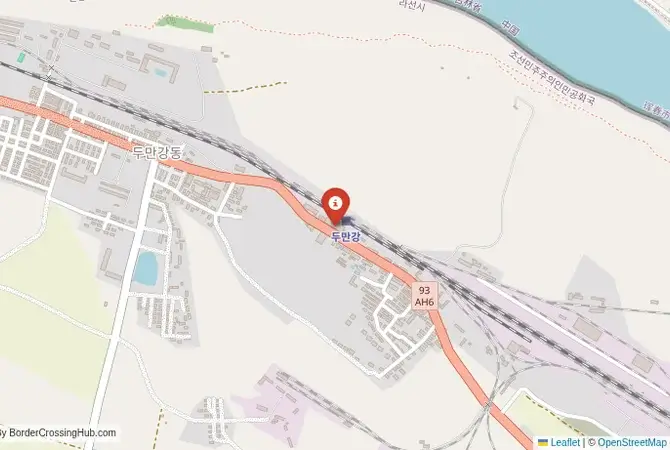
The border crossing at the Russian settlement of Khasan, which connects to the North Korean special economic zone of Rason via the town of Tumangang, is exclusively a railway crossing. The border is the Tumen River, and the crossing is a simple, functional railway bridge known as the "Friendship Bridge." This is the shortest international border Russia has, a mere 17 kilometers. The crossing is located in a remote and strategically vital corner of Northeast Asia, at the tri-point where the borders of Russia, North Korea, and China meet. The atmosphere here is one of profound isolation, secrecy, and immense security. This is not a place of commerce or tourism in any normal sense. It is a tightly controlled political and strategic valve, a physical manifestation of the unique and historically deep relationship between Moscow and Pyongyang. It is a border that feels like a relic of the Cold War, a passage into the world's most isolated state. Passenger rail service resumed in 2025 after multi-year hiatus, with direct long-distance trains (e.g., Pyongyang-Moscow) operating periodically, alongside high freight volumes; a new parallel road bridge is under construction since 2025, expected completion mid-2026.
A History of a Cold War Lifeline
The history of this crossing is the history of the Soviet Union's relationship with North Korea. The railway bridge was built in 1959 as a key strategic and economic lifeline from the USSR to its communist ally. During the Cold War, it was a vital conduit for Soviet aid, military hardware, and political influence into North Korea. It was the primary physical link between the two countries. The settlement of Khasan on the Russian side exists solely to serve this railway border. After the collapse of the Soviet Union, the relationship changed, but the border remained a crucial, if diminished, link. In the 21st century, there have been various projects to upgrade the railway and to use the crossing to connect the Trans-Siberian Railway with a future Trans-Korean Railway, a grand vision that is currently stalled by the political situation. The crossing remains a powerful symbol of the enduring, if complex, strategic partnership between Russia and North Korea. Direct passenger rail (e.g., long routes) restarted in mid-2025, with freight rail activity remaining high into 2026.
Nearby Border Crossings
Border Procedures: A Highly Controlled State Affair
As it is impossible for ordinary travelers to cross here, the following is a description of the process for the very few who are authorized. The Process: All travel is by train. The train service is infrequent and is not a regular passenger service. The border formalities are conducted on the train and at the border stations of Khasan and Tumangang. The process is extremely slow and meticulous. On both sides, armed guards patrol the train. Immigration and customs officials from both countries will board the train to conduct their checks. On the North Korean side, the inspection is exhaustive. All luggage is completely searched. All electronic devices, books, and papers are inspected for any prohibited content. The officials are polite but extremely thorough. The entire process can take many hours. It is a highly controlled and intimidating experience, designed to ensure that nothing and no one enters or leaves the country without the state's full knowledge and approval. Procedures remain state-exclusive with no changes for independent access; new road bridge (under construction) will add vehicle capacity post-2026 but under strict controls.
The Regional Context: The Tumen River Tri-Point
The crossing is located in an exceptionally sensitive geopolitical area. The Tumen River, which forms the border, is very narrow in this region. A short distance upriver is the tri-point where Russia, North Korea, and China meet. The Chinese city of Hunchun is nearby, and China has long had ambitions to gain access to the Sea of Japan via the Tumen River, a plan that would require the cooperation of both Russia and North Korea. The entire region is a high-security zone on all three sides. On the Russian side, Khasan is in a closed military district that requires special permits to visit, even for Russian citizens. On the North Korean side, the crossing leads into the Rason Special Economic Zone, an area that has been designated for foreign investment but has had limited success. It is a region of immense strategic calculation and very little actual movement for ordinary people.
Final Contextual Note: The World's Most Closed Border
The Khasan-Tumangang Friendship Bridge is arguably the most closed and inaccessible international border crossing in the world. It is a functional railway link, but one that serves purely state-level strategic and economic interests. It is not a gateway for people, but a carefully controlled conduit between two authoritarian states. For the traveler, it is a place of immense fascination, a point on the map that represents the very edge of the accessible world. The story of this border is a powerful lesson in the nature of closed societies and the power of geopolitics to seal a frontier. It is a place to be read about and studied, but it is a journey that, for now, remains impossible to make.
View all border crossings between Russia and North KoreaPractical information
Currency
Exchange near Khasan (RUB, KPW)
Safety information
Restricted, security risks
Connectivity
Limited Wi-Fi, 3G
Have you crossed here?
Help other travelers by sharing your experience, wait times, and any updates.