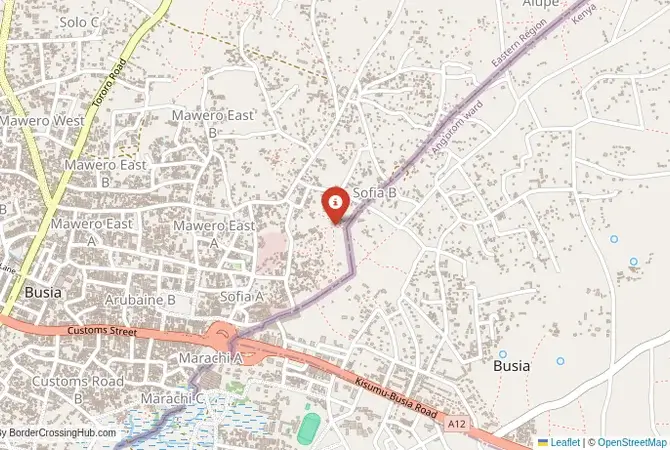
Monthly Update (October 2026):
Busia Border Crossing remains one of the busiest Kenya-Uganda gateways in October, handling substantial passenger and commercial movement. Uganda's trade portal continues to list the post as operating around the clock, while the two countries are also considering an additional crossing at Mulwada to serve communities currently using informal boat routes across the Sio River. That proposal is longer-term and does not change the normal Busia crossing this month.
About this crossing
A History of a Market Town on a Colonial Line
The history of this crossing is the history of local trade. The town of Busia grew up as a market center on the main road between Kenya and Uganda. The border is a legacy of British colonialism, a line drawn between the Uganda Protectorate and the Kenya Colony. For decades, it was a relatively soft frontier. The crossing's modern character was shaped by the formation of the East African Community (EAC). The goal of the EAC is to create a single market and to facilitate the free movement of people and goods. The Busia border is a key testing ground for this vision. To manage the immense volume of traffic, a modern "One-Stop Border Post" (OSBP) was built with international support. The idea of the OSBP is to streamline the crossing process by having officials from both countries work in a single facility. While the infrastructure is new, the sheer volume of informal, small-scale trade and human traffic means that the area around the formal crossing remains a chaotic and vibrant marketplace. It is a border that perfectly illustrates the tension between the vision of a modern, streamlined frontier and the messy, vibrant reality of everyday African commerce.
The Border Crossing Procedure: The One-Stop Border Post
The border is open 24 hours. The process is now consolidated into the One-Stop Border Post, which makes it much more efficient than in the past, though it can still be very crowded. You must have the correct visas. The One-Stop Process: The new OSBP is a large, modern complex. The key principle is that you only stop once. When you are exiting one country, you also complete the entry formalities for the next country in the same building. Exiting Kenya and Entering Uganda: You will arrive at the OSBP on the Kenyan side. You will first go to the Kenyan immigration counter and get your passport stamped for exit. You will then walk a few meters to the Ugandan immigration counter, which is in the same hall. Here, you will present your passport. You can obtain a Ugandan visa on arrival, or an East African Tourist Visa. You will pay the fee in US dollars. You will also need your yellow fever vaccination certificate. After getting your Ugandan entry stamp, you will go through a single customs check. The process is designed to be linear and efficient. Exiting Uganda and Entering Kenya: The process is the same in reverse, taking place at the OSBP on the Ugandan side of town. You will get your Ugandan exit stamp and your Kenyan entry stamp in the same building. Kenya also offers a visa on arrival for many nationalities.
Nearby Border Crossings




Route, Onward Travel, and The "Boda-Boda" Phenomenon
This crossing is on the main highway between Kisumu in Kenya and Kampala in Uganda. The most common way to travel is by bus. Numerous companies (like Mash Poa) run direct, comfortable buses between major cities like Nairobi, Kampala, and Kigali (Rwanda) that use this crossing. The bus is a very convenient option. If you are traveling independently, you can take a local bus or matatu (minibus) to the border. The town of Busia is a major transport hub on both sides. The most striking feature of the crossing is the army of boda-boda (motorcycle taxi) riders who ferry people and goods across the short no-man's-land between the two posts. For a small fee, they will navigate you through the chaos. The road from the border to Kampala (about 4-5 hours) is a busy but paved highway that passes through the town of Jinja, the historic source of the Nile River, which is a major adventure tourism hub.
Final Planning Advice for the People's Gateway
The Busia crossing is a vibrant, chaotic, and classic African border experience. The new One-Stop Border Post has made the formal procedures much easier, but the surrounding atmosphere remains as energetic as ever. The key to a smooth crossing is to have your documents in order. Check the visa requirements for your nationality in advance, although visas on arrival are generally available. Have your yellow fever certificate ready. Taking a direct international bus is the most comfortable and hassle-free way to make the journey. Be prepared for crowds, noise, and a full immersion into the bustling commercial life of East Africa. This is not just a line on a map; it is the beating heart of the East African Community, a place of incredible energy and a testament to the deep connections that bind the region together.
View all border crossings between Kenya and UgandaPractical information
Fuel
Kenya: <1 km - Uganda: <1 km
Currency
Exchange near Busia (KES, UGX)
Safety information
Safe, traffic moderate
Connectivity
Wi-Fi at checkpoints, 4G
Have you crossed here?
Help other travelers by sharing your experience, wait times, and any updates.