Monthly Update (August 2026):
Bugarama–Goma remains a sensitive crossing in August because of the security situation around eastern DRC and the restrictions affecting movement from the Goma area. Rwanda still lists Bugarama among its official DRC border posts, but travelers should not assume that the crossing has the same level of accessibility as before the recent disruptions. The wider Rusizi border area is also subject to heightened security concerns.
About this crossing
The Bugarama-Kamanyola Crossing: The Rusizi Plain Route
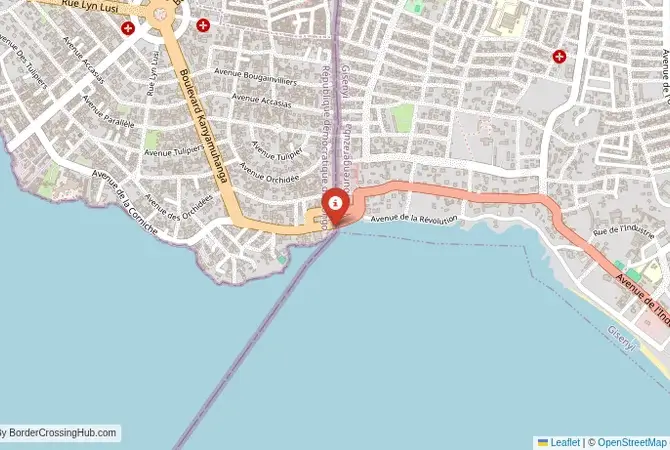
The border crossing near the Rwandan town of Bugarama, which connects to the Congolese town of Kamanyola, is a secondary gateway located on the fertile Rusizi Plain. This is the flat, low-lying land at the northern end of Lake Tanganyika that forms the border between Rwanda, Burundi, and the DRC. This is not a tourist crossing like the main "Grande Barrière" at Gisenyi-Goma. It is a local and commercial crossing, a dusty and functional outpost that serves the agricultural communities and trade routes of the region. The atmosphere is one of a tense, heavily militarized frontier. The crossing is a chokepoint in a region that has been at the heart of the Congo's long-running wars. For the traveler, this is a no-go zone, a passage through a landscape that is beautiful but has been profoundly and tragically scarred by decades of unrelenting violence.
A History on a Perpetual Frontline
The history of this border is the history of the Congo Wars. The Rusizi Plain has been a major strategic corridor for countless armed groups. Its location, at the intersection of three countries, has made it a perfect sanctuary, supply route, and battleground. During and after the 1994 Rwandan genocide, the area was a major route for refugees and Hutu militants fleeing into the Congo. This led directly to the First and Second Congo Wars, during which the Rwandan army and its allies used this corridor to pursue their enemies and to exert influence in the eastern Congo. The South Kivu province has been a perpetual battlefield ever since, home to a bewildering array of local and foreign armed groups, all fighting for control of land, resources, and political power. The Bugarama-Kamanyola crossing has been a constant feature in this conflict, a place where armies have crossed, and where civilians have been caught in the crossfire. It is a border that has known very little peace.
Nearby Border Crossings
Border Procedures: Not Applicable for Tourists
As this is not an official international crossing for foreigners, there are no procedures for tourists. The crossing is not equipped or authorized to process international travelers or issue visas.The Process for Local Traffic: For the local traders and residents who are permitted to cross, the process is dominated by security checks. The area is controlled by the national armies of both countries (the RDF and the FARDC) as well as a heavy UN peacekeeping (MONUSCO) presence. Movement is tightly controlled. All vehicles and individuals are subject to multiple, thorough searches and checks of their identification and permits. The atmosphere is intimidating, and the procedures are unpredictable.For a foreign traveler, there is no legal or practical way to cross here. Any foreigner arriving at this crossing would be immediately detained and subjected to intense questioning by security and intelligence officials from both countries. You would be suspected of being a mercenary, a spy, or a journalist trying to access the conflict zones without authorization. It is an extremely dangerous and ill-advised proposition.
The Regional Context: The South Kivu War Zone
The crossing connects the southwestern corner of Rwanda with the South Kivu province of the DRC. On the Rwandan side, the area is near the beautiful Nyungwe Forest National Park, but the immediate border area is a high-security zone. On the Congolese side, the road from Kamanyola leads to the city of Bukavu, the capital of South Kivu. The entire region is an active conflict zone. The roads are notoriously dangerous and are subject to frequent ambushes and illegal checkpoints by armed groups. The city of Bukavu itself is insecure. The only relatively safe way for a foreigner to visit this part of the DRC is by flying into Bukavu and being under the care of a major international organization like the UN, or to visit the Kahuzi-Biega National Park (for lowland gorilla trekking) as part of a highly organized tour that uses the main Rusizi I crossing, not this one.
Final Contextual Note: A Border to Be Avoided
The Bugarama-Kamanyola crossing is a functional, local border that exists in the middle of a war zone. It is a place that illustrates the grim reality of life in the eastern Congo, a region of stunning natural beauty that has been torn apart by decades of conflict. For the traveler, the message is absolute and unequivocal: this is a no-go zone. It is not a place for adventure but a place of extreme and unpredictable danger. The story of this border is a sobering lesson in the complexities of the Congo's wars and the devastating impact they have had on the people and the land. Any overland travel between Rwanda and the DRC must be done through the main, official international crossing at Gisenyi-Goma, and even then, only with the utmost caution and professional guidance.
View all border crossings between Rwanda and DR CongoPractical information
Fuel
Rwanda: <1 km - DR Congo: <1 km
Currency
Limited exchange (RWF, CDF)
Safety information
Restricted, security risks
Connectivity
Limited Wi-Fi, 3G
Have you crossed here?
Help other travelers by sharing your experience, wait times, and any updates.