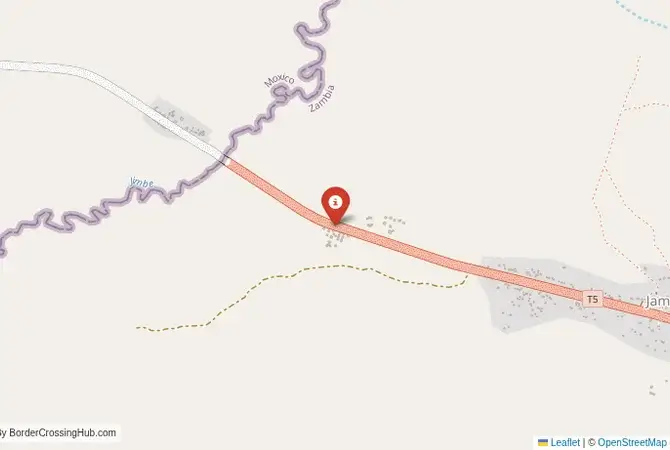
Monthly Update (September 2026):
Jimbe remains a quiet Zambia–Angola crossing with relatively little passenger traffic compared with Zambia's major regional gateways. Zambia has identified Jimbe as one of the crossings planned for development as a One Stop Border Post, alongside several other strategic frontier points. That is a longer-term infrastructure project rather than a September operational change, so travelers should still expect a remote crossing with limited services around it.
About this crossing
A History of a War-Torn and Porous Border
The history of this border is the history of the Angolan Civil War (1975-2002). The border is a colonial legacy, a line drawn by the British and Portuguese through the traditional lands of the Lunda and Luvale peoples. After Angolan independence, the eastern part of the country, particularly Moxico province, became a major stronghold for the UNITA rebel movement. The border with Zambia was a critical lifeline for UNITA, a route for supplies and a sanctuary for its fighters and their families. The region on the Zambian side became host to a massive population of Angolan refugees. The border was a highly militarized and dangerous zone. The end of the war in 2002 brought peace, but the region was left devastated and heavily contaminated with landmines. The reopening of the Jimbe crossing and the slow process of demining and rebuilding the roads has been a major post-war challenge. It is a border that is still emerging from the shadows of one of Africa's longest and most destructive conflicts.
The Border Crossing Procedure: A Basic and Rustic Affair
This is a very quiet border with very little traffic. The border is open from 06:00 to 18:00 daily. The facilities are very basic. You must have your visas sorted in advance. Exiting Zambia (Jimbe): The Zambian immigration and customs post is a very basic facility, likely a small, simple building. You will present your passport and get your exit stamp. The customs check for vehicles involves checking your temporary import permit. The process will be manual, with your details recorded in a ledger. The officials may be surprised to see a foreign traveler and the process, while friendly, may be slow. The No-Man's-Land: After clearing the Zambian side, you will proceed on a rough track through the bush to the Angolan side. Entering Angola (Jimbe): The Angolan post will be equally basic. You must have a pre-arranged Angolan visa. Visas on arrival are not available at this remote post. You will present your passport and visa to the immigration officer. You will also need your yellow fever vaccination certificate. The customs process for a vehicle will be a manual, bureaucratic affair. You will need a temporary import permit for Angola. The entire process requires a high degree of self-reliance and patience.
Nearby Border Crossings




Route, Onward Travel, and Extreme Challenges
This crossing is for 4x4 vehicles only. The roads on both sides are extremely challenging. On the Zambian side, the road from the provincial capital of Solwezi to the Jimbe border is under ongoing upgrades as part of the Lobito Corridor Development initiative, but remains a long and remote journey with limited infrastructure. On the Angolan side, the road from the border to the nearest major town, Luena, is a very long, slow, and arduous journey on sandy, unpaved tracks that can be impassable in the rainy season. This is one of the most remote and least-developed parts of Angola. You must be completely self-sufficient with multiple spare tires, recovery equipment, and enough fuel, food, and water for a multi-day expedition. There is no public transport on this route. The main caveat for any traveler is the uncertainty. The road conditions, the availability of fuel, and the security situation can all be unpredictable. The risk of landmines, while much reduced, is still a consideration in some off-road areas.
Final Contextual Note: A Route for Expeditionaries Only
The Jimbe crossing is a true overland expedition. It is not a border for tourists but for serious, well-equipped adventurers. The logistical challenges and uncertainties are immense. For almost all travelers, entering Angola is best done by air. For those determined to drive, this crossing is a legendary challenge. The key to a successful journey is meticulous planning and a very capable vehicle. You must have your Angolan visa in your passport before you arrive. You must have detailed maps and a GPS. And you must be prepared for a long and difficult journey through a very remote and wild part of the continent. It is a passage through a land that is still healing from a long and terrible war, a journey into the deep, beautiful, and challenging heart of Angola.
View all border crossings between Zambia and AngolaPractical information
Currency
Limited exchange (ZMW, AOA)
Safety information
Restricted, security risks
Connectivity
Limited Wi-Fi, 2G
Have you crossed here?
Help other travelers by sharing your experience, wait times, and any updates.