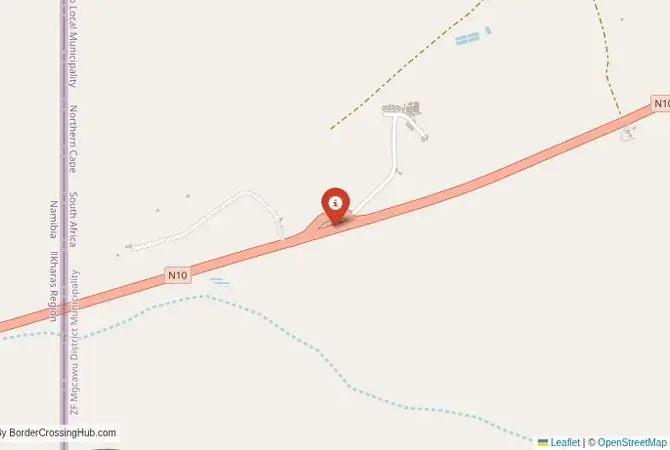
Monthly Update (October 2026):
Ariamsvlei & Nakop remains one of the principal Namibia-South Africa road gateways in October, with both sides continuing to list the crossing as active and available around the clock. It is the main commercial route toward Gauteng and the Northern Cape, so freight remains a more important source of traffic than at Namibia's smaller southern crossings. There is no significant new October restriction affecting ordinary travelers.
About this crossing
A History of a Railway and a New Highway
The history of this crossing is the history of the railway line that runs parallel to the road. The railway from the South African port of Port Elizabeth, through the Karoo, to the diamond fields of Kimberley and on into what was then German South West Africa, was a major artery of the colonial era. The border post grew up around this railway line. For many years, the road was a rough, unpaved track. The paving of the "Trans-Kalahari Highway" in the post-apartheid era was a major development project, part of a vision to create a new, efficient trade corridor linking the port of Walvis Bay in Namibia with the industrial center of Gauteng in South Africa. The Ariamsvlei-Nakop crossing was upgraded into a major, modern facility to serve this new highway. It has become a critical route for commercial trucks, as it is a more direct path for goods moving between the two countries' economic heartlands than the longer route via Cape Town. It is a border that has been transformed from a sleepy railway outpost into a modern highway corridor.
The Border Crossing Procedure: A Smooth and Efficient Process
The border is open 24 hours a day. The process is known for being very smooth, professional, and efficient. The lower volume of tourist traffic often makes it a faster and more relaxed experience than the Noordoewer crossing. Exiting Namibia (Ariamsvlei): You will arrive at the modern Namibian border post. You will go to the immigration hall and get your passport stamped for exit. The customs process for vehicles involves checking your road tax permit. The process is usually very quick. The No-Man's-Land: You will then drive a short distance through the flat, open Kalahari landscape to the South African side. Entering South Africa (Nakop): You will arrive at the large and modern South African border post. You will go to the immigration hall. For most nationalities, South Africa offers visa-free entry. The officer will check your passport and provide an entry stamp. After immigration, you will proceed to the customs office. The officials will check your vehicle's documents. They are particularly strict about ensuring that vehicles have the correct registration papers and cross-border authorization. The customs check for luggage is usually a brief formality for tourists. The entire process is well-organized and can often be completed in under an hour.
Nearby Border Crossings
Route, Onward Travel, and The Kalahari
This crossing is on the main B3/N10 highway. The road on both sides is a world-class, paved highway in excellent condition, though it is a very long and monotonous drive. On the Namibian side, the road leads from the city of Keetmanshoop, the main hub of southern Namibia. On the South African side, the road connects to the town of Upington, on the banks of the Orange River. Upington is a major agricultural center and a transport hub for the Northern Cape province. From Upington, the main N14 highway continues east towards Johannesburg. For those without a car, there are direct, high-quality international bus services (like Intercape) that run between Windhoek and Johannesburg via this crossing. This is a very comfortable and convenient option. The main attraction of this route is the landscape itself: the vast, empty beauty of the Kalahari. The Kgalagadi Transfrontier Park, one of the largest and wildest conservation areas in the world, is also accessible from this corridor, though it requires a significant detour on gravel roads.
Final Planning Advice for the Kalahari Route
The Ariamsvlei-Nakop crossing is a modern, efficient, and quiet border. It is the best and most direct gateway for overland travel between central Namibia and the economic heartland of South Africa. The key to a successful crossing is to have all your documents in order, especially your vehicle registration and cross-border authorization letters if you are driving. Taking one of the direct international bus services is an excellent, hassle-free alternative. The 24-hour operation of the border provides great flexibility. This is a journey through a landscape of profound emptiness and subtle beauty. It is a border that works, a smooth and easy passage on a modern highway that cuts a lonely path through the vastness of the Kalahari Desert.
View all border crossings between Namibia and South AfricaPractical information
Fuel
Namibia: <1 km - South Africa: ~130 km
Currency
Exchange near Ariamsvlei (NAD, ZAR)
Safety information
Safe, desert area
Connectivity
Wi-Fi at checkpoints, 4G
Have you crossed here?
Help other travelers by sharing your experience, wait times, and any updates.