Monthly Update (October 2026):
Hekou & Lao Cai enters October with continued attention on coordination between the two countries. Vietnamese and Chinese border-management authorities held a bilateral working meeting in September covering customs, immigration, quarantine and border-gate operations, with the aim of keeping clearance smooth. Hekou & Lao Cai remains one of the busiest Vietnam-China gateways, so commercial traffic is still the main factor that can make the crossing feel slower.
About this crossing
A History of a French Railway and a New Frontier
The history of this crossing is the history of the railway. In the late 19th and early 20th centuries, the French colonial authorities in Indochina built a narrow-gauge railway line from their port at Haiphong, through Hanoi, all the way up the Red River valley to Lao Cai and on to Kunming, the capital of Yunnan. This was a monumental feat of engineering, designed to give France access to the fabled mineral wealth and markets of southern China. Lao Cai and Hekou were developed as the key border towns on this railway line. For decades, this was the primary artery of trade in the region. The railway was heavily damaged during the 1979 Sino-Vietnamese War, and the border was closed. It reopened in the 1990s, and since then, the crossing has experienced an explosive boom. While the Chinese have built a new standard-gauge railway on their side, the road crossing has become the main engine of growth. Hekou has been transformed into a busy, modern city, and the bridge is a constant hive of activity, with thousands of traders and tourists crossing on foot every day.
The Border Crossing Procedure: A Walk Between Two Cities
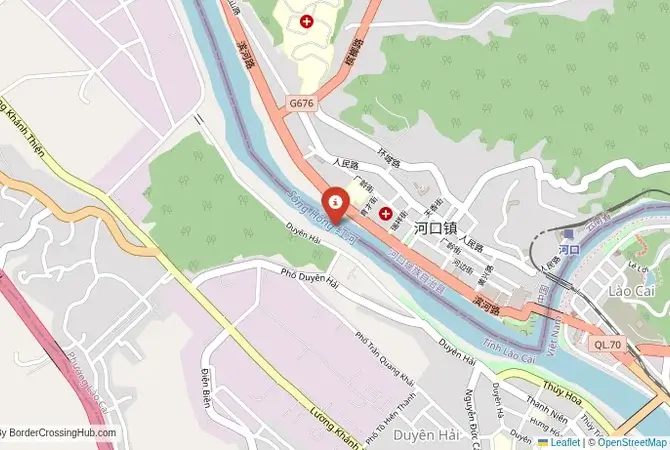
The border is open from 07:00 to 22:00 daily. The process is very well-organized and accustomed to handling large numbers of people, but it can be very crowded. You must have a valid visa for the country you are entering, obtained in advance. Exiting Vietnam (Lao Cai): The Vietnamese immigration and customs building is a large, modern facility located right at the entrance to the Hekou Bridge in the center of Lao Cai. You will enter the hall, present your passport and your Chinese visa to the immigration officer, and get your exit stamp. Your luggage will be passed through an X-ray scanner. The process is professional and efficient. The Hekou Bridge: After clearing Vietnamese immigration, you will walk across the bridge over the river. The bridge is always busy with pedestrians and offers a great view of the two cities and the river confluence. Entering China (Hekou): You will then enter the large and very modern Chinese port of entry building. The process here is thorough. You will first fill out an arrival card and have your fingerprints scanned at an automated kiosk. You will then queue for an immigration officer who will carefully inspect your passport and your Chinese visa before stamping you into the country. After immigration, all of your luggage must be put through an X-ray scanner for a detailed customs check. The officials are professional and the process is highly organized.
Nearby Border Crossings



Route, Onward Travel, and the Wonders of Yunnan
This crossing is the perfect gateway to Yunnan Province. On the Vietnamese side, Lao Cai is the final stop for the popular overnight sleeper trains from Hanoi. This is a very convenient and comfortable way to reach the border. Lao Cai is also the gateway to the famous mountain resort of Sapa, which is about a one-hour bus or taxi ride up into the mountains from Lao Cai. Many travelers spend a few days in Sapa before crossing into China. On the Chinese side, Hekou is a major transport hub. From the Hekou bus station, there are frequent services to the main destinations in southern Yunnan. The most popular route is to take a bus to the town of Xinjie, the base for visiting the spectacular Yuanyang Rice Terraces, a UNESCO World Heritage site. From there, you can continue to the historic towns of Jianshui and on to the provincial capital, Kunming. The roads in Yunnan are excellent, and the bus services are comfortable and efficient.
Final Planning Advice for the Yunnan Gateway
The Lao Cai-Hekou crossing is a vibrant, efficient, and highly recommended gateway between Vietnam and China. It is the best option for anyone traveling from the Hanoi/Sapa region to the beautiful province of Yunnan. The key to a successful crossing is to have your Chinese visa sorted out well in advance. The overnight train from Hanoi to Lao Cai is the classic way to arrive at the border. Be prepared for crowds, especially in the morning when the train passengers arrive, and for a very thorough security check on the Chinese side. This crossing is a fantastic and exciting experience, a direct passage from the mountains of northern Vietnam into the rich history, diverse cultures, and breathtaking landscapes of southern Yunnan.
View all border crossings between Vietnam and ChinaPractical information
Fuel
Vietnam: <1 km - China: <1 km
Currency
Exchange near Lao Cai (VND, CNY)
Safety information
Safe, traffic moderate
Connectivity
Wi-Fi at checkpoints, 4G
Have you crossed here?
Help other travelers by sharing your experience, wait times, and any updates.