Monthly Update (September 2026):
Alashankou & Dostyk remains a major Kazakhstan-China gateway, but freight traffic is subject to a formal electronic queue and waiting-area system. Kazakhstan's live register showed vehicles already accumulating in the Dostyk waiting area at the start of September, with some bookings scheduled several days ahead. The checkpoint is operating 24 hours, while its permitted vehicle capacity is scheduled to change several times later in September, including a reduction to 192 vehicles per day on September 24 and 180 from September 30. Travelers should therefore expect the biggest delays on the freight side rather than assume the border is a quick drive-through.
About this crossing
A History of Nomads, Railways, and Geopolitics
The Dzungarian Gate has been a highway for migrating peoples and conquering armies for thousands of years, from the Scythians to the Mongols of Genghis Khan. It was a key section of the northern Silk Road. In the 20th century, its strategic importance took a new form. During the Sino-Soviet split, this border became a tense, militarized frontier. The Soviets built their railway line to the town of Druzhba (meaning "Friendship," now Dostyk) in the 1950s, but the Chinese did not complete their side of the link until 1990, after relations had thawed. The connection of the two rail systems at Alashankou-Dostyk was a landmark event, creating an uninterrupted "New Eurasian Land Bridge" connecting China's ports with Europe. In the 21st century, with the launch of the Belt and Road Initiative, this crossing has exploded in importance. It is now one of the busiest land ports in the world, a key chokepoint for the container trains that shuttle goods between China and Europe. The entire infrastructure of both Dostyk and Alashankou has been built to serve this massive logistical operation.
The Border Crossing Procedure: A Complex and Restricted Process
This border crossing is not designed for independent travelers. It is overwhelmingly a rail freight border. While there is a road crossing, it is primarily for commercial trucks. Independent tourists in private vehicles are generally not permitted to cross here. The only way for a traveler to cross is typically as a passenger on infrequent cross-border bus or train services, but these are limited and difficult to arrange for foreigners. The Process: The procedure is notoriously slow, bureaucratic, and intense, especially on the Chinese side. You should budget an entire day for the crossing. The border has a long lunch break during which everything closes. You will first exit Kazakhstan at the Dostyk post. This involves a standard passport check (including your migration card) and a customs inspection. You will then be transported across the several kilometers of no-man's-land to the Chinese port of Alashankou. The entry into China is extremely thorough. Your passport and Chinese visa (which must be obtained in advance) will be scrutinized. You will be fingerprinted and photographed. Your luggage will be completely unpacked and inspected, and your electronic devices, particularly your phone and laptop, will be taken and scanned for prohibited content. This is a standard procedure at Chinese land borders. The officials are professional but operate with a high level of security consciousness. Any non-compliance or argument will result in denial of entry. After clearing all checks, you will be in the city of Alashankou, a place that exists solely to serve the border port.
Nearby Border Crossings




Route, Landscape, and Important Caveats
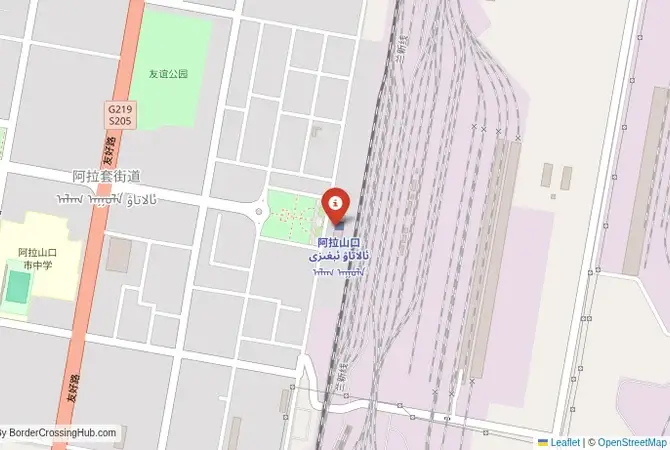
The crossing is located in a very remote part of both countries. Dostyk is a small Kazakh town built around the railway station. Alashankou is a larger, modern Chinese city that has been built from scratch in the desert. The most significant caveat is that this border is not a practical option for most tourists. The restrictions on private vehicles, the infrequent passenger services, and the intense, time-consuming nature of the checks make it a logistical nightmare. The Khorgos crossing, further south, is the designated and much more user-friendly gateway for tourists. The Dzungarian Gate is famous for its ferocious winds, which can blow relentlessly for days, sometimes halting all traffic. It is a harsh and unforgiving environment. Any attempt to use this crossing would require extensive prior research, flexibility, and a high tolerance for bureaucratic hurdles. You would need to confirm the existence and schedule of a cross-border bus service, which can be very difficult to do from outside the immediate region.
Final Contextual Note: A Commercial Juggernaut
The Dostyk-Alashankou crossing is a fascinating place to understand the scale and ambition of modern global logistics and China's role within it. It is a place where geography, history, and economics collide in a dramatic and powerful way. However, it is not a tourist-friendly border. It is a highly specialized port of entry designed for freight and tightly controlled movement. For the overland traveler in Central Asia, the clear and recommended choice for entering or exiting China is the Khorgos crossing. Dostyk-Alashankou is best appreciated from a distance, as a symbol of the new Silk Road, a river of steel containers flowing through the ancient, windy pass of the Dzungarian Gate.
View all border crossings between Kazakhstan and ChinaPractical information
Fuel
Kazakhstan: <1 km - China: <1 km
Currency
Exchange in Dostyk (KZT, CNY)
Safety information
Controlled area, heavy freight
Connectivity
Wi-Fi zones, 4G
Have you crossed here?
Help other travelers by sharing your experience, wait times, and any updates.