Monthly Update (September 2026):
Eilat & Wadi Araba remains an operating Jordan-Israel crossing, but travelers should plan around a temporary September restriction. Israel's Airports Authority has announced that private vehicles cannot leave Israel for Jordan through the Yitzhak Rabin/Wadi Araba crossing from September 15 through September 20 because of expected congestion before Yom Kippur. The restriction specifically affects private vehicles leaving Israel; it does not mean the entire crossing is closed to all passenger movement. Jordan currently lists Wadi Araba's normal hours as 07:30–21:00 Sunday-Thursday and 09:00–21:00 Friday-Saturday.
About this crossing
Operational Details
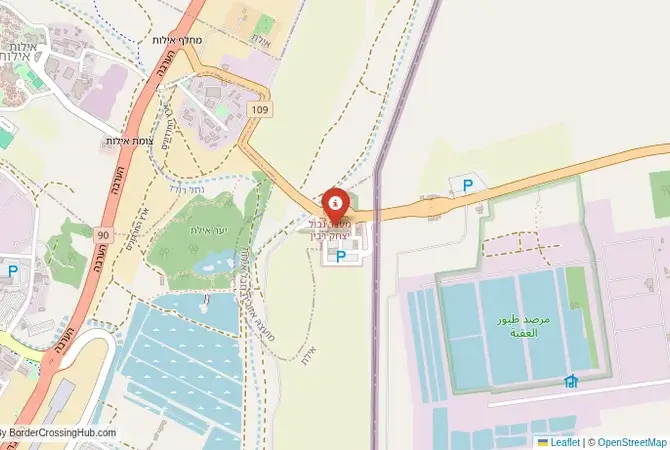
This checkpoint, officially named the Yitzhak Rabin/Wadi Araba Crossing, connects the Aqaba Governorate of Jordan with the Southern District of Israel. It is a major international crossing, but its hours can be variable, and it is often closed on major Jewish and Islamic holidays. It is essential to check the current schedule before travel. The crossing is open to international tourists and their private vehicles. The facility is modern and is located just a few kilometers north of the cities of Aqaba and Eilat, in the middle of the desert valley.
A History of a Peace Treaty
The history of this crossing is the history of the Israel-Jordan peace treaty. For decades, this was a closed and hostile military frontier. The Arava Valley was a line of conflict. The 1994 peace treaty transformed the relationship between the two countries. The Wadi Araba crossing was opened shortly after the treaty was signed, at the very spot where the historic signing ceremony took place. It was a powerful and tangible symbol of the new era of peace and cooperation, specifically designed to foster the growth of tourism, the most important industry for both the Aqaba and Eilat regions.
Nearby Border Crossings


The Border Crossing Procedure
The border crossing procedure is a complex, multi-stage, and often very slow process, particularly on the Israeli side. You will first complete exit formalities at the Jordanian checkpoint, which includes paying a Jordanian exit tax. You will then walk or drive a few hundred meters through a neutral zone to the Israeli terminal. Here, you will undergo a rigorous and meticulous security and immigration check by Israeli authorities. This can involve detailed questioning about your travel plans, your background, and your reasons for visiting. Be prepared for a potentially long and stressful experience. You will need a valid passport. Visa requirements vary by nationality. Be aware that an Israeli stamp in your passport may prevent you from entering some other countries in the Middle East.
The Surrounding Region: Jordan Side
On the Jordanian side, the crossing is the gateway to the magnificent desert landscapes of southern Jordan. The main attraction is the ancient Nabatean city of Petra, one of the New Seven Wonders of the World, a vast city of tombs and temples carved into the red sandstone cliffs. The spectacular desert scenery of Wadi Rum, a UNESCO World Heritage site famous for its dramatic sandstone mountains and its connection to Lawrence of Arabia, is also a short drive away. The port city of Aqaba on the Red Sea is Jordan's premier beach resort, a major destination for diving and snorkeling in the rich coral reefs.
The Surrounding Region: Israel Side
On the Israeli side, the crossing is just outside the city of Eilat. Eilat is Israel's southernmost city and its premier resort on the Red Sea. The city is famous for its beautiful coral reefs, which are part of a protected nature reserve, and its world-class diving and snorkeling. The Eilat Mountains offer stunning desert hiking trails. The Timna Park, with its ancient copper mines and spectacular rock formations, including "Solomon's Pillars," is also nearby. Eilat is also a gateway to the Sinai Peninsula in Egypt, via the nearby Taba border crossing.
Practical Travel Information
Practical planning is absolutely essential for this route. You must have all your documents in perfect order. The official currencies are the Jordanian Dinar (JOD) in Jordan and the Israeli Shekel (ILS) in Israel. Be prepared to pay the Jordanian exit tax. Private cars are allowed to cross, but the process can be complex and expensive, involving insurance and other fees. Many travelers cross as foot passengers and take a taxi on the other side. Be prepared for a significant change in security atmosphere when you cross into Israel.
Final Considerations
The Wadi Araba border crossing is a journey into the heart of a land of desert beauty and ancient history. It is a modern checkpoint that is a symbol of a historic peace treaty, but it operates with the high security that is a constant reality of the region. It is a gateway to some of the most important tourist sites in the world. For the traveler, it is a formal and meticulous process, a passage that requires patience and an understanding of the complex political context. It is a bridge that connects two nations, a journey across the beautiful and stark Arava desert.
View all border crossings between Jordan and IsraelPractical information
Fuel
Jordan: 500 m - Israel: 500 m
Currency
Near Eilat; JOD, ILS
Safety information
Generally safe; busy holidays
Connectivity
Wi-Fi, 4G/5G
Have you crossed here?
Help other travelers by sharing your experience, wait times, and any updates.