Monthly Update (September 2026):
Balakan & Lagodekhi remains an important Georgia-Azerbaijan crossing on the northern route, but it is not currently a normal tourist entry point into Azerbaijan by road. Azerbaijan's rules continue to require special permission for foreigners entering via land borders, while foreigners can leave Azerbaijan overland without that permission. Georgia continues to list Lagodekhi as an international motorway checkpoint, so the crossing remains operational from the Georgian side. Travelers should not confuse an operational checkpoint with unrestricted tourist entry into Azerbaijan.
About this crossing
Operational Details
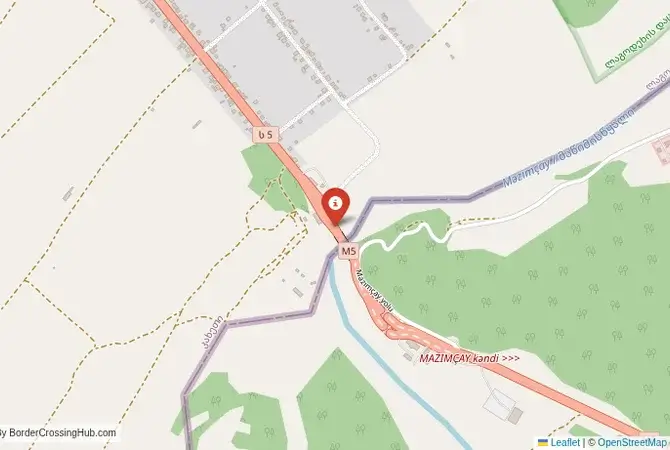
This checkpoint connects the Balakan District of Azerbaijan with the Kakheti region of Georgia. It is a major international crossing, open 24/7 to all passenger cars, buses, and commercial freight. The facility is modern and designed to handle a significant volume of traffic. It is the most popular crossing for tourists exploring the northern parts of both countries and is a vital link for regional trade. While it can be busy, the queues are generally more manageable than at the Red Bridge, making it an attractive alternative for many travelers; recent 2025-2026 reports indicate passenger car waits typically 30 minutes to 1 hour outside peaks, with no major delays or closures noted.
A History of a Multicultural Borderland
The history of this region is one of a multicultural borderland. The area has been shaped by Georgian, Azerbaijani (or Azeri Turk), Albanian (the ancient Caucasian kingdom, not the Balkan country), and other cultures for centuries. It was part of the medieval kingdom of Hereti and was later contested by Georgian kings and local khanates. The modern border is a legacy of the Soviet administrative divisions between the Georgian SSR and the Azerbaijan SSR, which often cut across communities with shared ethnic and family ties, including a significant Georgian minority on the Azerbaijani side. The open border has been crucial for maintaining these deep-rooted connections.
Nearby Border Crossings

Border Crossing Procedure
The border crossing procedure is a standard two-part process. You will first complete exit formalities at one country's checkpoint and then proceed to the other country's checkpoint for entry inspection. You will need a valid passport. Many nationalities can enter both countries visa-free, but it is essential to check the specific requirements for your nationality in advance. Vehicle registration and international insurance (Green Card) are also necessary. You may be required to pay various road or environmental taxes. The process is generally straightforward, but as at any major crossing, it is wise to allow for some buffer time in your schedule; no significant procedural changes reported in 2025-2026.
The Surrounding Region: Azerbaijan Side
On the Azerbaijani side, the crossing is in the Balakan District, in the foothills of the Greater Caucasus. The nearby city of Zaqatala is a historic and multicultural center, with a beautiful old town, a fortress from the Russian imperial era, and a unique history of resistance to the Russian Empire led by Imam Shamil. The region is known for its stunning natural beauty, with dense forests, rivers, and mountains. The Zagatala State Reserve is a major protected area. The region is also known for its production of hazelnuts and its unique local cuisine. The magnificent historic city of Shaki, with its Khan's Palace, a UNESCO World Heritage site, is a few hours' drive away.
The Surrounding Region: Georgia Side
On the Georgian side, the crossing is in the Kakheti region, the heart of Georgia's ancient wine-making tradition, a practice that is on the UNESCO list of Intangible Cultural Heritage. The nearby town of Lagodekhi is the gateway to the Lagodekhi Protected Areas, one of the oldest and most pristine nature reserves in the Caucasus, a place of incredible biodiversity with deep gorges, waterfalls, and glacial lakes. The region is a paradise for hikers and nature lovers. The beautiful historic town of Sighnaghi, the "City of Love," with its preserved city walls and stunning views of the Alazani Valley, is also in this region.
Practical Travel Information
Practical planning for this route is straightforward. The main road is well-maintained. The official currencies are the Azerbaijani Manat (AZN) in Azerbaijan and the Georgian Lari (GEL) in Georgia. Currency exchange facilities are available at the border, but rates are often better in the cities. Ensure your vehicle's Green Card insurance explicitly covers both Georgia and Azerbaijan. Services like petrol stations are readily available on the main route. This crossing is an excellent choice for a tourist itinerary that includes both the Kakheti wine region and the historic cities of northern Azerbaijan; monitor official border sites for real-time queue information.
Final Considerations
The Balakan–Lagodekhi border crossing is a journey through a landscape of spectacular natural beauty and immense cultural and historical significance. It is a vital link for tourism and trade, connecting some of the most famous attractions in both Georgia and Azerbaijan. It is a passage that follows a path through the foothills of the mighty Caucasus. For the traveler looking to explore the ancient wine cellars of Kakheti, the pristine forests of Lagodekhi, and the historic Khanates of Azerbaijan, it is an essential and unforgettable route.
View all border crossings between Azerbaijan and GeorgiaPractical information
Fuel
Georgia: 500 m - Azerbaijan: 500 m
Currency
Exchange nearby; GEL, AZN
Safety information
Busy periods
Connectivity
Wi-Fi, 4G
Have you crossed here?
Help other travelers by sharing your experience, wait times, and any updates.