Monthly Update (September 2026):
Posof Ardahan & Vale remains an active Georgia-Türkiye road crossing, with no significant September closure identified. Georgia's Revenue Service continues to list Vale as an active customs border point on the Türkiye frontier. The crossing provides a useful inland alternative to the busier Sarpi gateway on the Black Sea coast. Travelers should expect a quieter route, although the mountainous approach through northeastern Türkiye and southern Georgia can add substantially more driving time than the border processing itself.
About this crossing
Operational Details
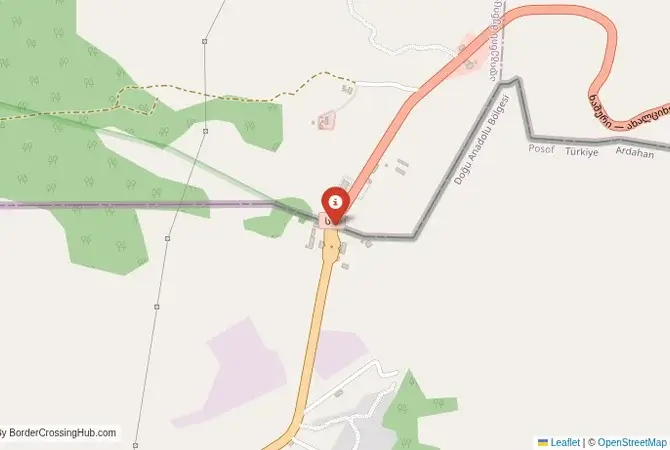
This checkpoint connects Georgia's Samtskhe-Javakheti region with the Ardahan Province of Turkey. It is a major international crossing, open 24/7 to both passenger cars and commercial freight. It is located on the main road that connects the Georgian city of Akhaltsikhe with the Turkish city of Ardahan. The facility is located at a high altitude, and it can be subject to harsh winter conditions, with heavy snow sometimes making travel difficult. It is a vital link for trade and tourism between the two countries, an alternative to the main coastal crossing at Sarpi; recent 2025-2026 reports from border authorities indicate generally light traffic with short waits (often under 1 hour) outside any rare seasonal peaks, and no major closures or restrictions noted.
A History of Tao-Klarjeti
The history of this region is the history of Tao-Klarjeti, a collection of medieval Georgian principalities that were a major center of Christian culture and art from the 9th to the 11th centuries. The landscape on both sides of the border is dotted with the magnificent ruins of Georgian Orthodox monasteries and churches from this golden age, such as the monasteries of Bana and Parkhali in Turkey. The region was conquered by the Ottoman Empire, and after World War I, the border was drawn through this historic Georgian land. The opening of this border has been crucial for Georgian scholars and pilgrims to access these important historical sites and for the development of cross-border cultural tourism.
Nearby Border Crossings


Border Crossing Procedure
The border crossing procedure is a standard two-part process. You will first complete exit formalities at one country's checkpoint and then proceed to the other country's checkpoint for entry inspection. You will need a valid passport, a visa for Turkey (if required for your nationality), vehicle registration, and international insurance (Green Card). The process takes place in a large, modern facility, and as traffic is generally lighter than at Sarpi, it is often a relatively fast and efficient crossing, with manageable queues; no significant procedural changes reported in 2025-2026.
The Surrounding Region: Georgia Side
On the Georgian side, the crossing is just a short drive from the city of Akhaltsikhe. The main attraction here is the magnificent, recently restored Rabati Castle, a vast fortress complex that includes a mosque, a church, a synagogue, a palace, and a museum, reflecting the multicultural history of the region. The crossing is also a gateway to the famous cave city of Vardzia, a stunning 12th-century monastery complex carved into the side of a cliff, and the beautiful Borjomi-Kharagauli National Park, famous for its mineral water.
The Surrounding Region: Turkey Side
On the Turkish side, the crossing is in the Ardahan Province, one of the highest, coldest, and most remote parts of Turkey. The nearby town of Posof is a small, high-altitude settlement. The road from the border leads towards the city of Ardahan and the historic city of Kars. The region is known for the ruins of numerous Georgian churches, the most famous of which is the magnificent cathedral at Bana. The area is also known for the "Devil's Castle" (Şeytan Kalesi) near the town of Çıldır. The stunning Lake Çıldır is also in this region.
Practical Travel Information
Practical planning is essential for this route. You must have a suitable vehicle and be prepared for high-altitude driving. Check the weather and road conditions before you set out, especially in winter. The official currencies are the Georgian Lari (GEL) in Georgia and the Turkish Lira (TRY) in Turkey. Services at the border are limited. It is essential to plan for fuel and any currency exchange in the larger towns of Akhaltsikhe or Ardahan. Ensure your vehicle's Green Card insurance explicitly covers both Georgia and Turkey; monitor official border sites for real-time status and any seasonal weather impacts.
Final Considerations
The Vale–Posof border crossing is a journey through a landscape of stunning natural beauty and immense historical significance. It is a vital link for tourism and trade, connecting some of the most famous attractions in both Georgia and eastern Turkey. It is a passage that follows a path through the heart of the ancient Georgian kingdom of Tao-Klarjeti. For the traveler interested in history, architecture, and dramatic mountain scenery, it is an essential and unforgettable route, a gateway to a lost golden age.
View all border crossings between Georgia and TurkeyPractical information
Fuel
Georgia: 2 km - Turkey: 2 km
Currency
Nearby kiosks; GEL, TRY
Safety information
Light traffic
Connectivity
Basic data
Have you crossed here?
Help other travelers by sharing your experience, wait times, and any updates.