Monthly Update (September 2026):
Gradiška & Stara Gradiška remains one of the busiest Bosnia and Herzegovina-Croatia gateways, but September conditions have been relatively manageable compared with some other crossings. On September 3, live monitoring showed only about two cars at Bosanska Gradiška, while Croatian traffic information on September 4 later reported around 1 hour 30 minutes entering Croatia at the new Gradiška crossing. The contrast shows how quickly the queue can change during the day. Travelers should check the current direction-specific wait before setting out.
About this crossing
Operational Details
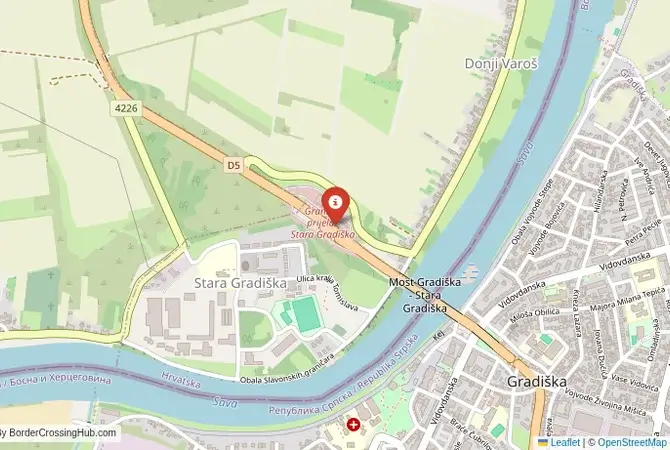
This checkpoint connects the Gradiška Municipality of Bosnia and Herzegovina with Brod-Posavina County of Croatia. It is a major international crossing, open 24/7 to both passenger cars and commercial freight. The facility is located on an old bridge that runs directly through the centers of the two towns, which can lead to significant congestion. It is one of the busiest crossings on the Sava River, a vital link for traffic moving between the Bosnian city of Banja Luka and the main Zagreb-Belgrade motorway in Croatia. A new, modern motorway bridge has been built nearby, but as of mid-2024, the connecting roads on the Bosnian side are not yet complete, so the old city crossing remains the primary route.
A History of a Military Frontier
The history of this region is the history of the Sava River as a major frontier. It was the border of the Roman Empire, and later the military frontier between the Habsburg and Ottoman Empires. The town of Stara Gradiška was a major fortress on this frontier. During World War II, it was the site of a notorious concentration and extermination camp, part of the Jasenovac complex, where tens of thousands of Serbs, Jews, and Roma were killed. During the Yugoslav era, this was an internal administrative line. The breakup of Yugoslavia and the Bosnian War turned it into a major international border. The crossing has been a witness to the many layers of the region's complex and often violent history.
Nearby Border Crossings

The Schengen Border Procedure
The border crossing procedure is a rigorous and meticulous process, reflecting its status as a primary entry point into the EU and the Schengen Area. You will first complete exit formalities at the Bosnian checkpoint in the center of Gradiška. After crossing the bridge, you will arrive at the Croatian checkpoint in Stara Gradiška for a full EU/Schengen entry inspection by the Croatian Border Police and Customs. You will need a valid passport. National ID cards are only sufficient for EU citizens. Vehicle registration and international insurance (Green Card) are also necessary. As a Schengen entry point, the checks are very thorough, and the location of the checkpoint in the town center often leads to long queues that snake through the streets.
The Surrounding Region: Bosnia and Herzegovina Side
On the Bosnian side, the crossing is in the city of Gradiška, a major commercial and agricultural center in the Republika Srpska entity. The city is located in the Lijevče polje, a fertile plain known for its vegetable production. The crossing is the main gateway to the beautiful city of Banja Luka, the de facto capital of Republika Srpska, with its historic Kastel fortress and the beautiful Ferhadija Mosque. The Kozara National Park, a forested mountain famous as a World War II partisan stronghold, is also in this region.
The Surrounding Region: Croatia Side
On the Croatian side, the crossing is in the historic region of Slavonia. The village of Stara Gradiška is small, but the crossing provides a direct link to the main A3 motorway, the primary east-west corridor in Croatia, connecting Zagreb with Belgrade. The region of Slavonia is known as the breadbasket of Croatia, a land of vast, fertile plains, oak forests, and rich folk traditions. The Lonjsko Polje Nature Park, one of the largest protected wetlands in Europe and famous for its traditional wooden houses and free-roaming horses, is also in this region.
Practical Travel Information
Practical planning for this route requires patience. Be prepared for potentially long wait times, especially during peak seasons, due to the urban location of the checkpoint. The official currencies are the Bosnian Convertible Mark (BAM) in Bosnia and Herzegovina and the Euro (EUR) in Croatia. Services are widely available in the towns on both sides of the border. Ensure your vehicle's Green Card insurance is valid for both countries. The completion of the new motorway bridge in the coming years is expected to dramatically improve the flow of traffic.
Final Considerations
The Gradiška–Stara Gradiška border crossing is a vital economic artery that operates under the strain of its outdated, urban infrastructure. It is a journey through a region with a deep and often somber history. It is a border that is defined by the slow-moving queues of trucks and cars, a testament to the importance of the connection between Bosnia and the EU. The new bridge on the horizon promises a more efficient future, but for now, this old bridge remains the workhorse of the Sava River, a place where the past and the future of the Balkans meet.
View all border crossings between Bosnia and Herzegovina and CroatiaPractical information
Fuel
Bosnia and Herzegovina: 500 m - Croatia: 500 m
Currency
Exchange offices; BAM, EUR
Safety information
High traffic; orderly controls
Connectivity
Wi-Fi, 4G/5G
Have you crossed here?
Help other travelers by sharing your experience, wait times, and any updates.