Monthly Update (October 2026):
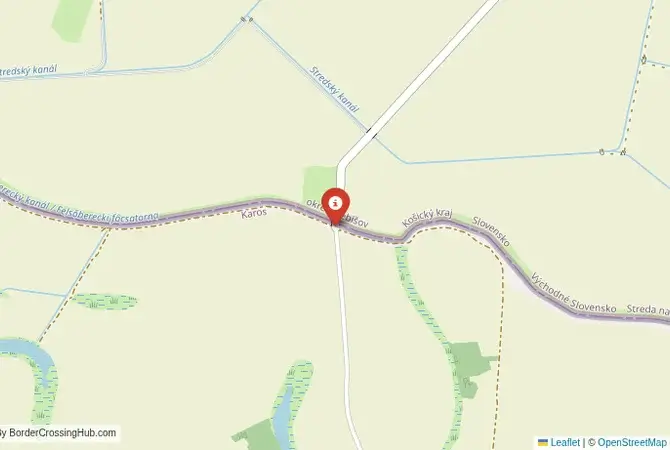
The Karos & Streda nad Bodrogom Border Crossing remains a small regional connection in the eastern Slovakia-Hungary border area. With both countries inside Schengen and no temporary controls currently introduced on this frontier, travelers should not expect routine passport checks. The main October considerations are local road conditions and the limited traffic capacity of the surrounding rural roads.
About this crossing
Operational Details
This checkpoint connects Slovakia's Košice Region with Hungary's Borsod-Abaúj-Zemplén County. It is a regional road, open 24/7, and used primarily by local traffic and tourists interested in history and archaeology. The former border posts are now abandoned. Traffic flows freely, and the only signs of the border are the standard blue EU signs. The crossing is a vital link for the local communities, many of whom are ethnically Hungarian, allowing for easy access to services and family on both sides of the border.
A History of the Magyar Conquest
The history of this crossing is the history of the Hungarian conquest of the Carpathian Basin. The Bodrogköz region is famous for the discovery of a series of magnificent 9th and 10th-century cemeteries belonging to the conquering Magyar chieftains. The richest of these graves were found right here, in the area around Karos. The treasures unearthed from these sites, including ornate silver sabretaches, weapons, and jewelry, are among the most important artifacts of the early Hungarian period and are now housed in the Hungarian National Museum in Budapest. The border, established after World War I, divided this archaeologically rich landscape. The open Schengen border has allowed for joint research and the promotion of a shared historical heritage.
Nearby Border Crossings
The Seamless Border Procedure
Today, there is no border procedure for travelers. You simply drive through the flat plains. There are no passport checks and no customs inspections. This is the reality of the Schengen Area. However, it is important to remember that both Hungarian and Slovak police and customs authorities can and do perform random checks on vehicles anywhere in their territory. You are still required to carry a valid passport or national ID card with you at all times. The open border has allowed for the creation of cross-border historical and cultural routes.
The Surrounding Region: Slovakia Side
On the Slovak side, the village of Streda nad Bodrogom has a beautiful Romanesque-Gothic church. The area is part of the Medzibodrožie Protected Bird Area, a haven for ornithologists. The nearby town of Kráľovský Chlmec is the main center of the region. The crossing is also a gateway to the famous Tokaj wine region, a UNESCO World Heritage site, which straddles the Slovak-Hungarian border. The Slovak part of the Tokaj region is just a short drive away.
The Surrounding Region: Hungary Side
On the Hungarian side, the village of Karos is home to an archaeological park and a visitor center dedicated to the Magyar Conquest era, where you can learn about the incredible discoveries made in the area. The crossing is a gateway to the Hungarian part of the Bodrogköz and the world-renowned Tokaj wine region. The nearby town of Sárospatak is a major historical and cultural center, with a famous Rákóczi castle. The town of Sátoraljaújhely, which was itself divided by the border, is also nearby.
Practical Travel Information
Practical planning for this route is very simple. The most important thing is to have the required motorway vignettes if your journey involves motorways in either country. Both Slovakia and Hungary use an electronic vignette system, which must be purchased online in advance. The official currencies are the Euro (EUR) in Slovakia and the Hungarian Forint (HUF) in Hungary. Services are available in the larger towns on both sides of the border. The roads are regional and well-maintained.
Final Considerations
The Streda nad Bodrogom–Karos border crossing is a journey into the deep past of the Hungarian nation. It offers a peaceful and uncomplicated passage through a landscape of immense archaeological importance. It is a border that you might not even notice you have crossed, a testament to the success of the Schengen project in this unique and culturally rich corner of Central Europe. For those interested in history, archaeology, and the origins of Hungary, it is an essential and fascinating route to explore.
View all border crossings between Slovakia and HungaryPractical information
Fuel
Slovakia: 1 km - Hungary: 1 km
Currency
Limited nearby (EUR, HUF)
Safety information
Low crime, rural zone
Connectivity
4G / 5G coverage
Have you crossed here?
Help other travelers by sharing your experience, wait times, and any updates.