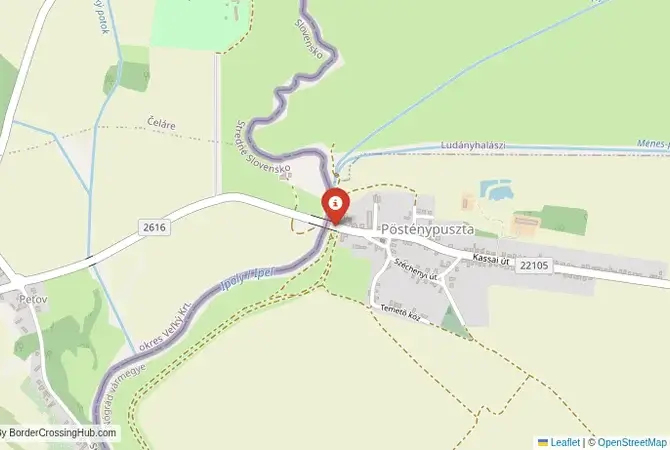
Monthly Update (November 2026):
Kováčovce–Szécsény has seen little significant change in November, with no major disruption reported at the Katalin Bridge. The surrounding Ipoly Valley continues to benefit from its network of smaller cross-border road connections, but no new restriction or construction project has been identified on this bridge during the month. For travelers using the route toward Szécsény, there is little evidence of a different crossing experience from October.
Driving there, or sending a driver? Send them this guide.
For reports and websites
Cite this page
Border Crossing Hub (2026). Kováčovce & Szécsény Border Crossing. Updated November 2026. https://bordercrossinghub.com/kovacovce-szecseny-katalin-bridge-border-crossing/<a href="https://bordercrossinghub.com/kovacovce-szecseny-katalin-bridge-border-crossing/">Kováčovce & Szécsény Border Crossing (Border Crossing Hub)</a>Put this crossing's card on your website
Free. It updates on its own when our information changes.
<iframe data-bch-card src="https://bordercrossinghub.com/kovacovce-szecseny-katalin-bridge-border-crossing/?bch_view=card" width="100%" height="980" scrolling="no" style="border:0;max-width:480px;display:block" loading="lazy" title="Kováčovce & Szécsény border crossing information"></iframe>
<p style="font-size:12px;margin:4px 0 0">Crossing information: <a href="https://bordercrossinghub.com/kovacovce-szecseny-katalin-bridge-border-crossing/">Border Crossing Hub</a></p>
<script src="https://bordercrossinghub.com/?bch_embed_js=1" async></script>Paste it where you want the card. The last line (a script) only adjusts the height and can be left out.
About this crossing
Operational Details
This checkpoint connects Slovakia's Banská Bystrica Region with Hungary's Nógrád County. It is a regional road, open 24/7. The new bridge, named the "Katalin Bridge," is designed for passenger cars, cyclists, and pedestrians, with a weight limit that excludes the heaviest freight traffic. Traffic flows freely, and the only signs of the border are the standard blue EU signs. The bridge has a dedicated lane for cyclists and pedestrians, making it a key part of the growing network of cycling trails in the Ipoly valley. It is a vital link for the local communities and for tourists exploring the region.
A History of a Severed Connection
The history of this crossing is a story of a long-severed connection. The original bridge here was destroyed in World War II. For the entire duration of the Cold War, and for decades after, there was no bridge. The Ipoly River, which forms the border, was a hard, guarded frontier. The fall of the Iron Curtain and the accession of both countries to the EU created the opportunity to restore the link. The construction of the new bridge was a major joint project, co-funded by the EU's Interreg program, and its opening was a huge celebration for the local communities, a tangible symbol of a reunited Europe and the "Ipoly Bridges" program, which has rebuilt numerous bridges along the river.
The Seamless Border Procedure
Today, there is no border procedure for travelers. You simply drive, cycle, or walk across the beautiful new bridge. There are no passport checks and no customs inspections. This is the reality of the Schengen Area. However, it is important to remember that both Hungarian and Slovak police and customs authorities can and do perform random checks on vehicles anywhere in their territory. You are still required to carry a valid passport or national ID card with you at all times. The bridge offers stunning views of the Ipoly River and the historic skyline of Szécsény.
The Surrounding Region: Slovakia Side
On the Slovak side, the crossing is in the historic Novohrad (Nógrád) region. The village of Kováčovce is a quiet, rural settlement. The nearby town of Veľký Krtíš is the main administrative and economic center of the district. The area is known for its wine production and its beautiful, hilly landscape, which is part of the Krupinská planina highlands. The region has a significant Hungarian minority population.
The Surrounding Region: Hungary Side
On the Hungarian side, the crossing is in the heart of Nógrád County, a region known for its rich history, its traditional "Palóc" folk culture, and its many castles and ruins. The bridge leads directly to the historic town of Szécsény, which has a beautifully restored historic town center and a magnificent baroque Forgách Castle. The town is famous for being the site of the 1705 Diet of Szécsény, where Francis II Rákóczi was elected ruling prince of Hungary. The UNESCO World Heritage village of Hollókő, with its perfectly preserved traditional folk architecture, is also in this county and is a major tourist attraction.
Practical Travel Information
Practical planning for this route is very simple. The most important thing is to have the required motorway vignettes if your journey involves motorways in either country. Both Slovakia and Hungary use an electronic vignette system, which must be purchased online in advance. The official currencies are the Euro (EUR) in Slovakia and the Hungarian Forint (HUF) in Hungary. Services are widely available in the larger towns on both sides of the river. The new bridge and its approach roads are modern and in excellent condition.
Final Considerations
The Kováčovce–Szécsény border crossing is a shining example of the positive impact of European integration at the local level. The new bridge is more than just a piece of concrete and steel; it is a symbol of friendship, cooperation, and a shared future. It offers a beautiful and efficient passage through a region rich in nature and history. It is a border crossing that is not about division, but about connection, a testament to the power of infrastructure to bring people and communities together and to heal the wounds of the 20th century.
Nearby Border Crossings


Heading to Kováčovce & Szécsény? Take this with you.
One page with the hours, waits, emergency numbers and coordinates. Works without signal.
Practical information
Fuel
Slovakia: 1 km - Hungary: 1 km
Currency
Limited locally (EUR, HUF)
Safety information
Quiet zone, low crime
Connectivity
4G/5G coverage
Have you crossed here?
Help other travelers by sharing your experience, wait times, and any updates.