Monthly Update (October 2026):
The Jarovce & Kittsee Border Crossing is currently affected by Austria's renewed temporary controls on its border with Slovakia, introduced for September 16, 2026 through March 15, 2027. Selective checks can therefore add some delay even though both countries are in Schengen, particularly on the busy Bratislava-Vienna corridor. Travelers should carry valid identification and allow some extra time during busier periods.
Driving there, or sending a driver? Send them this guide.
For reports and websites
Cite this page
Border Crossing Hub (2026). Jarovce & Kittsee Border Crossing. Updated October 2026. https://bordercrossinghub.com/jarovce-kittsee-border-crossing/<a href="https://bordercrossinghub.com/jarovce-kittsee-border-crossing/">Jarovce & Kittsee Border Crossing (Border Crossing Hub)</a>Put this crossing's card on your website
Free. It updates on its own when our information changes.
<iframe data-bch-card src="https://bordercrossinghub.com/jarovce-kittsee-border-crossing/?bch_view=card" width="100%" height="980" scrolling="no" style="border:0;max-width:480px;display:block" loading="lazy" title="Jarovce & Kittsee border crossing information"></iframe>
<p style="font-size:12px;margin:4px 0 0">Crossing information: <a href="https://bordercrossinghub.com/jarovce-kittsee-border-crossing/">Border Crossing Hub</a></p>
<script src="https://bordercrossinghub.com/?bch_embed_js=1" async></script>Paste it where you want the card. The last line (a script) only adjusts the height and can be left out.
About this crossing
Operational Details
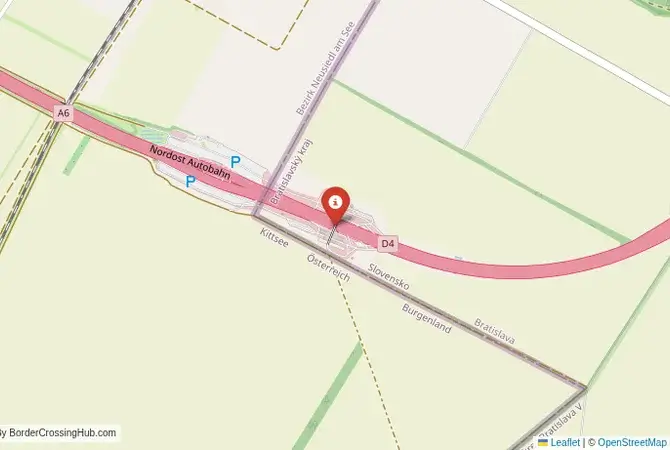
This checkpoint connects Slovakia's Bratislava Region with Austria's Burgenland state. It is a massive, multi-lane motorway crossing. While the permanent control booths are no longer in use, the facility is often used for temporary checks, particularly related to migration or security alerts. The crossing is open 24/7, and traffic flows freely at the posted speed limit. The only indication that you are crossing a border is a simple blue sign with the European Union stars. The crossing is used by a huge volume of traffic, including daily commuters, tourists, and heavy freight.
A History of the Iron Curtain
The history of this crossing is the history of the Cold War. For over 40 years, this was one of the most heavily fortified points on the Iron Curtain, the armed and guarded border between the communist Eastern Bloc and the West. The fields on the Slovak side were lined with barbed wire, watchtowers, and minefields to prevent citizens from escaping to Austria. Bratislava, despite being just a few kilometers from the border, was a world away from Vienna. The fall of the Iron Curtain in 1989 was a momentous event, and this border was one of the first places where the fences were cut. The accession of Slovakia to the Schengen Area in 2007 completed the process, dismantling the physical border for good.
The Seamless Border Procedure
Today, there is no border procedure for the vast majority of travelers. You simply drive along the motorway. There are no passport checks and no customs inspections. This is the reality of the Schengen Area. However, due to its strategic location, this crossing is frequently chosen by Austrian and Slovak authorities for temporary or random checks. You are still required to carry a valid passport or national ID card with you at all times. For the thousands of Slovaks who now live in the Austrian border villages and commute to work in Bratislava (or vice-versa), the open border is a fundamental part of their daily lives.
The Surrounding Region: Slovakia Side
On the Slovak side, the crossing is on the outskirts of the capital city, Bratislava. Bratislava has a beautifully restored old town, a magnificent castle overlooking the Danube River, and a vibrant cultural scene. The nearby Danubiana Meulensteen Art Museum, situated on a peninsula in the Danube, is a world-class modern art gallery. The area south of the Danube is known for its beautiful floodplain forests and lakes.
The Surrounding Region: Austria Side
On the Austrian side, the crossing is in the state of Burgenland. The village of Kittsee is famous for its apricot orchards and its beautiful 17th-century castle. The region is part of the Neusiedler See-Seewinkel National Park, a vast steppe lake and wetland area that is a UNESCO World Heritage site and a paradise for birdwatchers. The Austrian capital, Vienna, with its imperial palaces, world-class museums, and legendary coffee houses, is less than an hour's drive away.
Practical Travel Information
Practical planning for this route is very simple. The most important thing is to have the required motorway vignettes for both countries. Both Slovakia and Austria use an electronic vignette system, which must be purchased online in advance. The official currency in both countries is the Euro (EUR). Large service stations are available on the motorway on both sides of the former border. The proximity of the two capitals makes this an extremely busy route, so be prepared for heavy traffic, especially during rush hour.
Final Considerations
The Jarovce–Kittsee border crossing is a powerful symbol of a reunited Europe. The journey between Bratislava and Vienna, once a difficult and dangerous undertaking, is now a simple, seamless commute. The abandoned checkpoint buildings are a ghostly reminder of the Iron Curtain, while the free-flowing traffic is a celebration of the peace and freedom that have been won. It is a border that you cross without a thought, and that in itself is a remarkable testament to the profound changes that have swept across Central Europe.
Nearby Border Crossings
Heading to Jarovce & Kittsee? Take this with you.
One page with the hours, waits, emergency numbers and coordinates. Works without signal.
Practical information
Fuel
Slovakia: <1 km - Austria: <1 km
Currency
Not applicable (both use EUR)
Safety information
High traffic, orderly controls
Connectivity
4G/5G, checkpoint Wi-Fi
Have you crossed here?
Help other travelers by sharing your experience, wait times, and any updates.