Monthly Update (September 2026):
Łupków & Palota remains a railway border crossing rather than a normal road gateway. There is no September indication of a return to unrestricted international passenger rail service through the crossing. Travelers should therefore check the current train timetable before planning a journey, as the status of the railway route can differ from the road crossings in the region. It should not be treated as a car alternative to the nearby Slovakia-Poland road checkpoints.
About this crossing
Operational Details
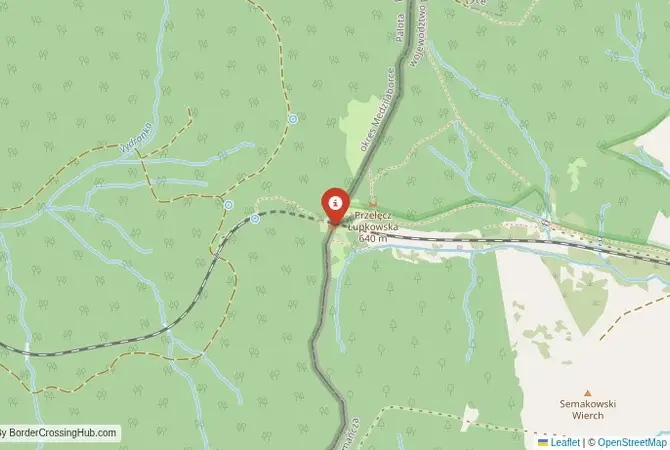
This checkpoint connects Poland's Podkarpackie Voivodeship with Slovakia's Prešov Region. Its operation is seasonal and often limited to tourist trains running on weekends during the summer months. It is not a major freight corridor. The key feature of the crossing is the Łupków Tunnel, a 642-meter-long tunnel that runs directly under the main ridge of the Carpathians and the border itself. The journey is the destination, a nostalgic trip on a historic line through a stunning natural landscape. Verifying the current train schedule is absolutely essential, as services are infrequent and subject to change.
A History of a Strategic Tunnel
The history of this crossing is the history of the Łupków Tunnel. The railway line was built by the Austro-Hungarian Empire in the 1870s as a strategic connection between Galicia (now in Poland and Ukraine) and the rest of the empire. The tunnel was a major engineering feat of its time. The pass and the tunnel were the scene of brutal fighting during both World War I and World War II. The tunnel was blown up by retreating German forces in 1944 and was rebuilt after the war. The region was the homeland of the Lemko (Rusyn) people, who were forcibly deported from the Polish side after World War II, leaving many villages abandoned. The railway line fell into disuse for many years before being revived as a tourist route.
Nearby Border Crossings

The Seamless Border Procedure
Today, there is no border procedure for travelers on the tourist trains. The train passes through the tunnel from one country to the other without stopping for checks. This is the reality of the Schengen Area. However, it is important to remember that both Polish and Slovak police and customs authorities can and do perform random checks on trains anywhere in their territory. You are still required to carry a valid passport or national ID card with you at all times.
The Surrounding Region: Poland Side
On the Polish side, the crossing is in the heart of the Bieszczady Mountains, a region famous for its wild, untamed beauty and its dark sky park. The area is a paradise for hikers, nature lovers, and those seeking solitude. The railway line is a tourist attraction in itself, with historic stations and beautiful scenery. The nearby town of Komańcza is known for its historic wooden churches and its connection to the Lemko culture. The region is dotted with the poignant remnants of the abandoned Lemko villages.
The Surrounding Region: Slovakia Side
On the Slovak side, the crossing is near the village of Palota. The line connects to the town of Medzilaborce, which is famous as the home of the Andy Warhol Museum of Modern Art. The pop artist's parents were Rusyns who emigrated from the nearby village of Miková. The museum is a surprising and world-class cultural institution in this remote region. The area is also known for its beautiful wooden churches and its Rusyn heritage. The Dukla Pass, the site of a major World War II battle, is also in this region.
Practical Travel Information
Practical planning for this route is entirely dependent on the seasonal train schedule. You must check with the official railway operators or local tourist information centers to see if and when the trains are running. Tickets must be booked in advance. The official currencies are the Polish Złoty (PLN) in Poland and the Euro (EUR) in Slovakia. Services are available in the larger towns like Medzilaborce and Sanok (in Poland), but the immediate border area is very remote.
Final Considerations
The Łupków–Palota railway crossing is a journey for the romantic, the historian, and the nature lover. It is a slow, beautiful trip through a wild and poignant landscape. The seamless Schengen passage through the historic tunnel is a remarkable experience. It is a border crossing that is not about speed or efficiency, but about reconnecting with history and nature. It is a testament to the power of tourism to revive and give new meaning to a historic piece of infrastructure that might otherwise have been forgotten.
View all border crossings between Poland and SlovakiaPractical information
Fuel
Slovakia: 15 km - Poland: 15 km
Currency
Limited nearby EUR, PLN
Safety information
Low crime rural rail
Connectivity
Basic 3G coverage
Have you crossed here?
Help other travelers by sharing your experience, wait times, and any updates.