Monthly Update (September 2026):
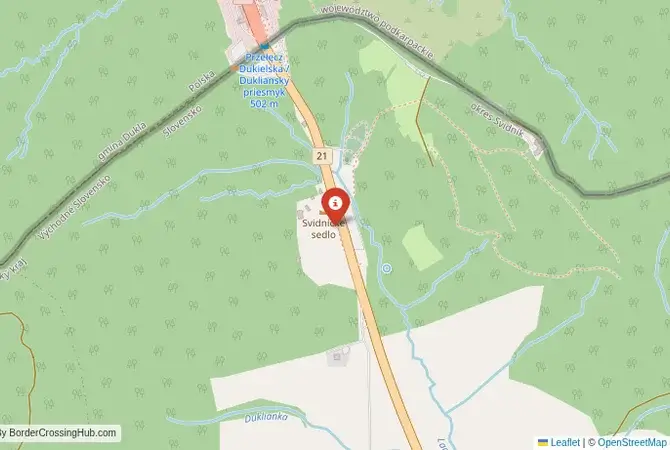
Barwinek & Vyšný Komárnik remains an important Slovakia-Poland road crossing, but September travelers should watch the approach roads carefully. Roadworks on Slovakia's R4 around Svidník began in July and have affected traffic between Poland and the Slovak interior, with Polish authorities warning that queues can develop around Vyšný Komárnik-Barwinek when traffic builds. Additional works on Poland's DK9 near Barwinek are scheduled to continue through the end of 2026, including lane narrowing associated with S19 construction. The border itself remains open, but the approaches can add time.
About this crossing
Operational Details
This checkpoint connects Slovakia's Prešov Region with Poland's Podkarpackie Voivodeship. It is the main international crossing in the eastern part of the border, a major 24/7 route for both passenger cars and heavy freight. The road (E371) is a key north-south artery, linking eastern Slovakia with southeastern Poland. The former border posts are now abandoned, and traffic flows freely. The crossing is a place of constant commercial movement, but it is impossible to drive through without being aware of the immense history of the location.
A History of the Dukla Pass
The history of this crossing is dominated by the events of autumn 1944. The Battle of the Dukla Pass was a massive offensive launched by the Soviet Red Army, with the inclusion of the 1st Czechoslovak Army Corps, to break through the German lines in the Carpathians and support the Slovak National Uprising. The battle turned into a brutal, two-month-long meat grinder, with horrific casualties on both sides. The fighting devastated the surrounding villages and forests. Today, the entire region is an open-air museum. An observation tower stands near the former border, and the road is lined with monuments, memorials, and military cemeteries dedicated to the Soviet and Czechoslovak soldiers who died here. The area near Svidník on the Slovak side is known as the "Valley of Death," where a major tank battle took place.
Nearby Border Crossings

The Seamless Border Procedure
Today, there is no border procedure for travelers. You simply drive through the pass. There are no passport checks and no customs inspections. This is the reality of the Schengen Area. However, it is important to remember that both Polish and Slovak police and customs authorities can and do perform random checks on vehicles anywhere in their territory, including near the former border. You are still required to carry a valid passport or national ID card with you at all times.
The Surrounding Region: Slovakia Side
On the Slovak side, the crossing is the gateway to the Prešov region, an area with a strong Rusyn (Ruthenian) cultural heritage. The town of Svidník has a major military history museum dedicated to the battle and an open-air museum of Ukrainian and Rusyn folk architecture. The nearby town of Bardejov is a UNESCO World Heritage site, with a perfectly preserved medieval town square. The region is also famous for its beautiful wooden churches, many of which are also on the UNESCO list.
The Surrounding Region: Poland Side
On the Polish side, the crossing is in the heart of the Beskid Niski, the lowest and wildest part of the Polish Carpathian mountains. The area is known for its beautiful, sparsely populated landscapes and its Lemko (Rusyn) heritage. The spa town of Iwonicz-Zdrój is nearby. The road leads towards the city of Rzeszów, the capital of the Podkarpackie Voivodeship. The entire region is dotted with World War I and World War II cemeteries, a testament to its history as a major European battlefield.
Practical Travel Information
Practical planning for this route is very simple. The most important thing is to have the required motorway vignettes if your journey involves motorways in either country. Both Slovakia and Poland use an electronic vignette system, which must be purchased online in advance. The official currencies are the Euro (EUR) in Slovakia and the Polish Złoty (PLN) in Poland. Services are available in the towns on both sides of the border. The mountain roads are well-maintained but can be challenging in winter, so it is important to have appropriate tires and to check the weather conditions.
Final Considerations
The Vyšný Komárnik–Barwinek border crossing is a journey through a landscape of immense historical weight. The seamless Schengen passage stands in stark contrast to the brutal battles that were fought here to cross this same line. It is a beautiful and scenic drive, but one that should be undertaken with a sense of reverence for the past. It is a border that you cross freely today because of the immense sacrifices that were made here, a powerful and moving testament to the difference between a continent at war and a continent at peace.
View all border crossings between Slovakia and PolandPractical information
Fuel
Slovakia: 1 km - Poland: 1 km
Currency
Nearby exchange EUR, PLN
Safety information
Busy but orderly
Connectivity
Checkpoint Wi-Fi, 4G/5G
Have you crossed here?
Help other travelers by sharing your experience, wait times, and any updates.