Monthly Update (August 2026):
The Bohumín & Čadca Border Crossing is still handling the heavier regional traffic expected on this important north-south route, but there is no sign of a new border-related disruption in August. The rail connection is also active, with direct Bohumín–Čadca trains continuing to link the two sides, which is useful for travelers who want to avoid the road altogether. Weekday road traffic can still build around the approaches, particularly at busier times, while evenings are generally quieter. For a crossing this close to both Poland and the Czech-Slovak transport corridor, the main practical issue this month is ordinary summer and commuter traffic rather than border processing.
About this crossing
Operational Details
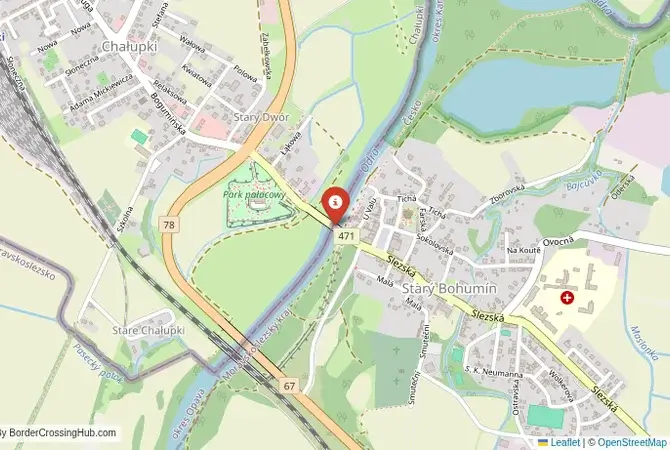
This checkpoint connects Slovakia's Žilina Region with the Moravian-Silesian Region of the Czech Republic. It is a massive, multi-lane motorway crossing that runs through the Jablunkov Pass in the Beskid Mountains. The Polish border is just a few kilometers away. While the permanent control booths are no longer in use, the facility can be reactivated for temporary checks. The crossing is open 24/7, and traffic flows freely. The only indication that you are crossing a border is a simple blue EU sign. The adjacent railway crossing is equally important, a key line for freight and passenger traffic.
A History of the Velvet Divorce and a Tripoint
The history of this crossing is the history of Czechoslovakia. For 75 years, this was an internal administrative line. This changed on January 1, 1993, with the "Velvet Divorce." The crossing was instantly transformed into a full-fledged international border. For over a decade, it was a place of passports, customs checks, and long queues. This all changed again in 2007 when both countries joined the Schengen Area, and the physical border controls were dismantled overnight. The proximity of the Polish border adds another layer of historical complexity, as this region, known as Cieszyn Silesia, has been contested by Poland and Czechoslovakia in the past.
Nearby Border Crossings
The Seamless Border Procedure
Today, there is no border procedure for the vast majority of travelers. You simply drive through the mountain pass at the motorway speed limit. There are no passport checks and no customs inspections. This is the reality of the Schengen Area. However, it is important to remember that the police and customs authorities of all three countries can and do perform random checks on vehicles anywhere in this border region. You are still required to carry a valid passport or national ID card with you at all times.
The Surrounding Region: Slovakia Side
On the Slovak side, the crossing is in the Kysuce region, a beautiful, hilly area known for its traditional wooden architecture and its unique "Kysuce-Orava" forestry railway. The nearby city of Žilina is a major economic and cultural center, with a beautifully restored historic square. The region is a gateway to the stunning mountains of the Malá Fatra and Veľká Fatra National Parks, which are popular for hiking and skiing.
The Surrounding Region: Czech Side
On the Czech side, the crossing is in the Moravian-Silesian Beskids, a mountain range known for its traditional Wallachian culture. The nearby industrial city of Ostrava is the third-largest city in the Czech Republic, with a fascinating industrial heritage, including the a UNESCO-listed former ironworks complex at Dolní Vítkovice. The city of Bohumín is a major railway hub. The area is a key part of the industrial heartland of the Czech Republic.
Practical Travel Information
Practical planning for this route is very simple. The most important thing is to have the required motorway vignettes for both countries (and Poland, if you plan to cross that border as well). Slovakia and the Czech Republic use an electronic vignette system (`elektronická diaľničná známka`), which must be purchased online in advance. The official currencies are the Euro (EUR) in Slovakia and the Czech Koruna (CZK) in the Czech Republic (and the Złoty in Poland). Large service stations are available on the motorway. The mountain roads can be challenging in winter, so it is important to have appropriate tires.
Final Considerations
The Čadca–Bohumín region border crossing is a powerful symbol of an integrated Central Europe. The massive, empty checkpoint buildings are a ghostly reminder of a divided past, while the free-flowing traffic is a celebration of the present. The seamless passage between three nations in the space of a few kilometers is a remarkable experience. It is a border that you might not even notice you have crossed, a testament to the success of the Schengen project in this historic and beautiful mountain region.
View all border crossings between Slovakia and Czech RepublicPractical information
Fuel
Slovakia: <1 km - Czech Republic: <1 km
Currency
Limited nearby EUR, CZK
Safety information
Generally safe
Connectivity
4G/5G coverage
Have you crossed here?
Help other travelers by sharing your experience, wait times, and any updates.