Monthly Update (September 2026):
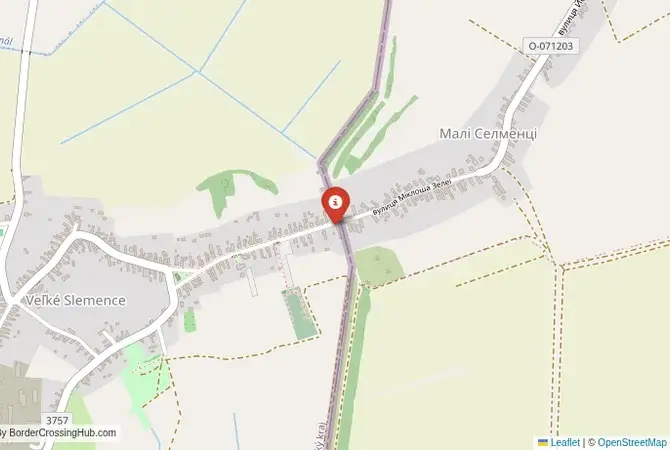
Mali Selmentsi & Veľké Slemence remains a pedestrian-and-cyclist crossing rather than a normal road checkpoint. Slovakia's current border information lists Veľké Slemence for pedestrians and cyclists and restricts use to citizens of Slovakia, Ukraine, the EEA and Switzerland. Current information shows the crossing operating normally, with pedestrian processing described as continuous and no reported queue. For travelers in cars, this crossing is not an alternative; it is mainly useful for people crossing on foot or by bicycle.
About this crossing
Operational Details
This checkpoint connects Ukraine's Zakarpattia Oblast with Slovakia's Košice Region. It is a pedestrian and cyclist-only crossing with operating hours that are typically from 8:00 AM to 8:00 PM. Its purpose is singular: to allow the residents of the divided village, and other local people, to cross the border without making a huge detour to the main road crossing at Uzhhorod. The checkpoint consists of two small buildings on either side of a gate, a simple but profoundly significant piece of infrastructure that reunites a community on a daily basis.
A History of a Line Through a Village
The history of this crossing is the story of the village of Szelmenc. For centuries, it was a single community, part of the Kingdom of Hungary, with a predominantly Hungarian population. After World War I, it became part of Czechoslovakia. The tragedy occurred in 1946, after the Soviet Union annexed Zakarpattia and established its border with the re-formed Czechoslovakia. The new border was drawn straight through the heart of the village, following a small stream. Soviet soldiers unrolled barbed wire down the main street, literally separating houses from their barns, and the cemetery from the church. For the next six decades, families could only wave and shout to each other across the fortified fence. The story of the divided village became a symbol of the absurdity of the Iron Curtain.
Nearby Border Crossings
The Opening of the Gate
After the fall of communism, residents on both sides began a long and arduous campaign to have a crossing point opened. After years of lobbying, international media attention, and diplomatic negotiations, a border crossing was finally opened on December 23, 2005. The event was a hugely emotional reunion, as elderly relatives who had not touched in over 60 years were finally able to embrace. The opening of the gate was a powerful symbol of the end of the Cold War's legacy in this small corner of Europe. A symbolic half-gate stands on each side of the border, inscribed with a poem by a local writer about the village's painful division and joyful reunion. The story was famously captured in the documentary film "The Border".
Border Crossing Procedure
The border crossing procedure is a standard process for entering the EU and the Schengen Area, but it is conducted on foot. You will first complete exit formalities at the Ukrainian checkpoint building in Mali Selmentsi. You will then walk a few meters through the gate to the Slovak checkpoint in Veľké Slemence for a full EU/Schengen entry inspection by the Slovak border police. You will need a valid passport and a Schengen visa (if required). The process is usually straightforward, but the checkpoint has become busier since 2022 as it provides another outlet for people leaving Ukraine, particularly those who live nearby and have relatives in Slovakia.
The Surrounding Region
The surrounding area is a flat, agricultural plain. The village itself is the main attraction, a living monument to a painful history. On both sides, you can see the symbolic half-gates and feel the unique atmosphere of a community that is both one and two. On the Ukrainian side, Mali Selmentsi is a small village. The nearest major city is Uzhhorod, the capital of Zakarpattia, with its beautiful castle and historic old town. On the Slovak side, Veľké Slemence is also a small village. The crossing is in the far eastern part of Slovakia, a region known for its rural landscapes and its Rusyn and Hungarian minority populations. The nearest major Slovak city is Košice, a beautiful historic city and a European Capital of Culture in 2013.
Final Considerations
The Mali Selmentsi–Veľké Slemence border crossing is more than a checkpoint; it is a place of pilgrimage. It is a journey that every student of European history should make. It tells a powerful, human-scale story of division and reunification, of the cruelty of geopolitics and the endurance of family bonds. The short walk through the gate is one of the most meaningful border crossings you can experience anywhere in the world. It is a testament to the fact that no fence can truly sever the connections between people, a quiet but profound symbol of hope on a continent with a long and often tragic history of division.
View all border crossings between Ukraine and SlovakiaPractical information
Fuel
Ukraine: <1 km - Slovakia: <1 km
Currency
Exchange nearby; UAH, EUR
Safety information
Moderate traffic
Connectivity
Wi-Fi, 4G
Have you crossed here?
Help other travelers by sharing your experience, wait times, and any updates.