Monthly Update (September 2026):
Kruglovka & Lyozno remains an approved Belarus-Russia international road route under the countries' bilateral border arrangements. Liozno-Kruglovka is explicitly one of the six designated road sections for foreign travelers, and crossings elsewhere along the shared land frontier are prohibited. No significant September closure has been identified. Travelers should nevertheless expect identity and immigration checks even though Belarus and Russia operate within the Union State framework.
About this crossing
Operational Details
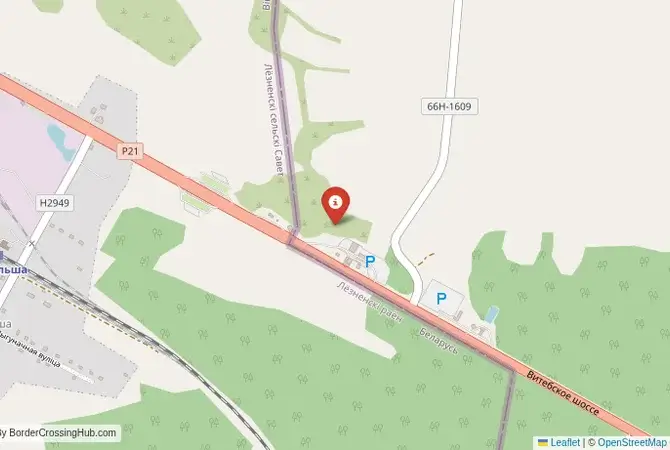
This checkpoint connects the Vitebsk Region (Viciebskaja voblasć) of Belarus with the Smolensk Oblast of Russia. It is a major crossing, typically open 24/7 and serving both passenger cars and commercial freight. It is located on the P21 highway. While it is designated as an international checkpoint, the primary users are citizens of Belarus and Russia. Third-country nationals should be extremely cautious and verify that this crossing is permitted for their nationality before attempting to use it, as they may be redirected to the main M1 highway crossing.
A History of a Contested Land
The history of this region is one of a deeply contested borderland. The area between Vitebsk and Smolensk has been part of Kievan Rus', the Grand Duchy of Lithuania, the Polish-Lithuanian Commonwealth, and the Russian Empire. The city of Smolensk, in particular, has been a fortress city, a "key to Russia," fought over for centuries. During World War II, the "Smolensk Gate" was the scene of a massive and brutal battle in 1941 and another major Soviet offensive in 1943. The entire region was devastated. The modern border is a legacy of the Soviet administrative divisions. The Union State agreement of the 1990s aimed to erase this line, but recent geopolitical events have seen it re-emerge with greater significance.
Nearby Border Crossings

Border Crossing Procedure
The border crossing procedure here reflects the complex nature of the Union State. For citizens of Russia and Belarus, the process is often streamlined, with a focus on customs control for goods rather than intensive immigration checks. For third-country nationals, the situation is much stricter. You will face full immigration and customs checks from both Belarusian and Russian authorities. You must have a valid passport and valid visas for both Belarus and Russia, if required for your nationality. The checkpoint facilities are substantial, designed to handle a significant flow of traffic, but the rules for international travelers can be inconsistently applied, making it a potentially problematic crossing with occasional delays.
The Surrounding Region
The surrounding area is rich in history. On the Belarusian side, Lyozno is a small town known for being the birthplace of the artist Marc Chagall's father (though Chagall himself was from Vitebsk). The nearby city of Vitebsk is a major cultural center, famous as the home of Chagall and the Suprematist artist Kazimir Malevich. The city hosts the annual "Slavianski Bazaar" international arts festival. On the Russian side, the crossing leads directly towards the ancient city of Smolensk. Smolensk is one of Russia's oldest cities, with a magnificent fortified Kremlin wall, beautiful churches, and numerous monuments commemorating its long and often tragic military history.
Practical Travel Information
Practical planning for this route requires careful research into the current regulations for international travelers. Do not assume that a visa for one country automatically grants you the right to cross this land border into the other. The highway is a major regional route and is well-maintained. The official currencies are the Belarusian Ruble (BYN) and the Russian Ruble (RUB). Services like petrol stations and currency exchange are available in the towns of Lyozno and Smolensk. Ensure your vehicle insurance (Green Card) is valid for both countries.
Final Considerations
The Lyozno–Kruglovka border crossing is a major regional gateway with a deep historical context. It connects two of the most historically significant cities in the Belarus-Russia borderland. For citizens of the Union State, it is a routine passage. For international travelers, it is a frontier that must be approached with caution and thorough preparation. It is a place that encapsulates both the shared cultural history of the region and the modern complexities of international border control in a rapidly changing geopolitical landscape.
View all border crossings between Belarus and RussiaPractical information
Fuel
Belarus: 2 km - Russia: 2 km
Currency
Nearby exchange; BYN, RUB
Safety information
Steady flow; minimal issues
Connectivity
4G coverage
Have you crossed here?
Help other travelers by sharing your experience, wait times, and any updates.