Monthly Update (September 2026):
Mohyliv-Podilskyi & Otaci remains one of the more important Moldova-Ukraine road crossings. No significant September closure has been identified, but travelers should expect tighter security procedures than at a normal European land border because of the war in neighboring Ukraine. The route remains useful for traffic between central Moldova and western Ukraine, although conditions can change quickly if security incidents affect the surrounding road network.
About this crossing
Operational Details
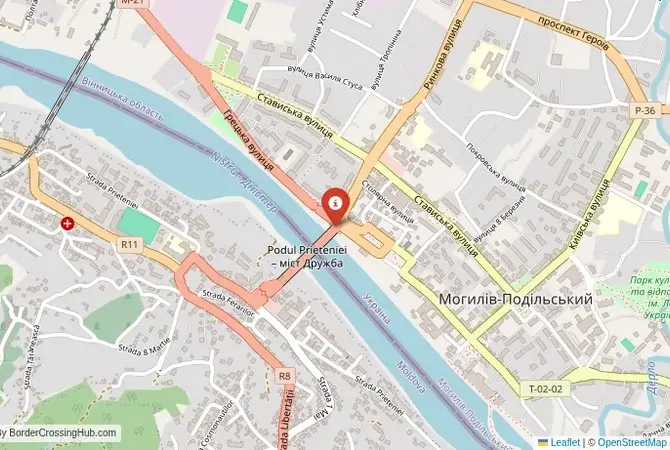
This checkpoint connects Moldova's Ocnița District with Ukraine's Vinnytsia Oblast. Its continuous operation is vital for the economies of both regions. The crossing is a large bridge that offers impressive views of the Dniester River and the cities that rise on its banks. It is the most direct route for travel between the Moldovan capital, Chișinău, and the Ukrainian capital, Kyiv, making it a critical piece of regional infrastructure. Its importance has only grown in the current geopolitical climate, as it remains a key link for both humanitarian and commercial traffic.
A History Shaped by the River
The history of this region is shaped by the Dniester River, which has for centuries served as both a major trade route and a contested frontier. The area has been part of the Principality of Moldavia, the Polish-Lithuanian Commonwealth, the Russian Empire, and the Soviet Union. The cities of Otaci and Mohyliv-Podilskyi have long been centers of trade and have historically had significant Jewish populations, forming part of the vibrant cultural tapestry of the historic Podolia region. The border drawn along the river is a 20th-century creation, but the connections between the communities on either side are much older. The bridge itself is a symbol of that enduring link, a physical structure that facilitates the daily interactions that have defined life on the Dniester for generations.
Nearby Border Crossings

Border Crossing Procedure
The border crossing procedure is a two-part process designed to handle high volumes of traffic. You will first complete exit formalities at the Moldovan checkpoint in Otaci. This is a large facility where border police and customs officials will check your passport and vehicle documents (registration and Green Card insurance). After being cleared, you will drive across the bridge over the Dniester. On the other side, you will arrive at the Ukrainian entry checkpoint in Mohyliv-Podilskyi for a full entry inspection by the Ukrainian State Border Guard Service. This will include passport checks and potential customs inspections. Given the crossing's importance, it can be very busy, and under the current geopolitical circumstances, wait times can be exceptionally long and unpredictable. Recent official reports indicate average waits of 1 to several hours for passenger vehicles, with extended delays possible for freight and during heightened periods.
Regional Attractions
The cities on either side of the border are interesting destinations. Mohyliv-Podilskyi is a historic city in Ukraine with several beautiful Orthodox churches, including a Greek cathedral from the 18th century and the St. Nicholas Cathedral. It has a pleasant riverside setting and serves as a major regional hub. On the Moldovan side, Otaci is a bustling border town. The nearby city of Soroca is one of Moldova's most famous tourist destinations, known for the magnificent Soroca Fortress, a perfectly preserved medieval fort that stands guard over the Dniester. Soroca is also known as the "Roma capital of Moldova," and the opulent houses built by the local Roma community in the hills above the city are a unique and striking architectural sight, drawing curious visitors from all over.
Essential Practical Planning
Practical planning is absolutely critical for this route, now more than ever. You must have the Moldovan road use vignette. Ukraine does not use a vignette system, but international vehicle insurance (the Green Card) is mandatory. The official currencies are the Moldovan Leu (MDL) and the Ukrainian Hryvnia (UAH). Services like petrol stations and currency exchange are available in both Otaci and Mohyliv-Podilskyi. However, it is crucial to be self-sufficient, with enough fuel, food, and water to endure potentially very long waits. The security situation can change rapidly, so all travel must be undertaken with extreme caution and a high degree of flexibility. Always check official sources for the latest travel advisories and entry requirements before attempting a journey.
Final Considerations
The Otaci–Mohyliv-Podilskyi crossing is a vital lifeline between Moldova and Ukraine. In normal times, it is a bustling symbol of the strong economic and social bonds between the two nations. Today, its primary characteristic is its role as a critical artery in a time of crisis. Any journey through this crossing is a direct encounter with the geopolitical realities of the region. It remains a powerful testament to the importance of the Dniester River as a historical and modern corridor, but one that must be approached with the utmost seriousness and preparation.
View all border crossings between Moldova and UkrainePractical information
Fuel
Moldova: 500 m - Ukraine: 500 m
Currency
Near Otaci (MDL, UAH)
Safety information
Busy, urban vicinity
Connectivity
Wi-Fi at site, 4G
Have you crossed here?
Help other travelers by sharing your experience, wait times, and any updates.