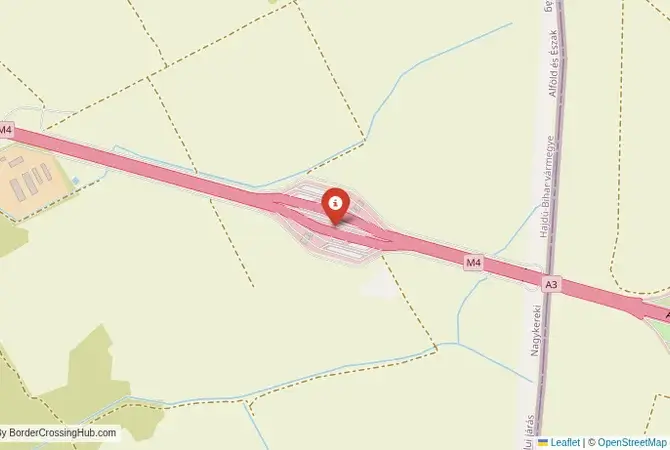
Monthly Update (September 2026):
Borș II & Nagykereki remains one of the principal motorway crossings between Hungary and Romania, but September traffic is currently manageable. On September 4, monitoring showed roughly 20 minutes toward Hungary during the day, while the opposite direction was around 15–20 minutes. The crossing operates 24/7 and routine Schengen border checks are no longer performed. Travelers using the A3/M4 corridor should still allow some buffer during busier Friday and weekend periods.
About this crossing
Operational Details
This 24/7 motorway crossing was opened in 2020 to relieve pressure on the original crossing (Borș I), which lies on the old national road a few kilometers away. The Borș II crossing allows long-distance traffic to bypass local towns completely, a crucial development for both international haulers and local residents. It connects Hungary's Hajdú-Bihar County with Romania's Bihor County and is the preferred route for the vast majority of long-distance passenger and commercial traffic. The facility is large, modern, and built to handle a massive volume of vehicles, representing a significant upgrade in the region's transport infrastructure.
A History of Modernization
The history of this crossing is very recent and is a story of infrastructure development. For decades, the old Borș I crossing was a notorious bottleneck, with freight trucks often queuing for many kilometers, causing significant delays and disrupting life in the local villages. The construction of the M4/A3 motorway link and the new Borș II checkpoint was a long-planned strategic project, co-funded by the European Union, to improve connectivity on the Pan-European Corridor IV. Its opening marked a new era of travel between Hungary and Romania, finally providing a high-speed, modern connection that matched the importance of the route.
Nearby Border Crossings


Border Crossing Procedure
Even on this new motorway, full document checks were previously required because Romania’s land borders were not part of the Schengen free-movement zone. Since January 1, 2025, with Romania's full accession to the Schengen Area, systematic border controls have been lifted at land crossings with Hungary. Travelers now cross without stopping for routine passport or ID checks, exit/entry stamps, or queues at booths. Random checks may still occur in the border area. A valid passport or EU ID card, along with vehicle registration and insurance, should still be carried. Non-EU travelers follow standard Schengen entry rules.
A Point of Transit
The main purpose of this crossing is to get you to your next destination quickly. The primary city on the Romanian side is Oradea (Nagyvárad), a major regional center famous for its spectacular, recently restored Art Nouveau and Secessionist architecture. The motorway takes you directly to the city's outskirts. On the Hungarian side, the M4 provides a fast link to Debrecen and onwards to Budapest. Other than these major cities, the immediate area is largely agricultural plains. The crossing itself is not a destination but a functional tool for efficient travel.
Practical Travel Information
Using this crossing means you are on the motorway, so purchasing the required road vignettes is mandatory. You must have the Hungarian `e-matrica` and the Romanian `rovinietă`. Both can be easily bought online ahead of time. Large, modern service stations are available on both sides of the border, providing fuel, food, and currency exchange. The official currencies are the Hungarian Forint (HUF) and the Romanian Leu (RON). The signage is clear, directing passenger cars and trucks into their respective lanes well in advance of the checkpoint. With Schengen integration, crossings are now seamless with no significant queues reported.
Final Considerations
The Nagykereki–Borș II crossing is the definition of a modern, functional border. It prioritizes speed and volume over all else. For long-distance travelers on a schedule, it is the undisputed best choice. While the original Borș I crossing still serves local traffic in some capacity or has been affected by closures post-Schengen, Borș II is the true artery, ensuring that the economic and social lifeblood of the two countries can flow with minimal interruption. It is a landscape of pure function, a place you pass through but never truly visit, a testament to the modern era of European transit.
View all border crossings between Hungary and RomaniaPractical information
Fuel
Hungary: <1 km - Romania: <1 km
Currency
Near Nagykereki (HUF, RON)
Safety information
Rural, low crime
Connectivity
4G/5G coverage
Have you crossed here?
Help other travelers by sharing your experience, wait times, and any updates.