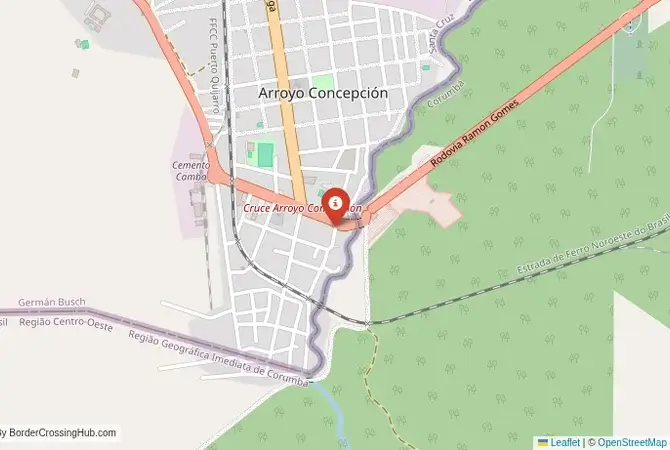
Monthly Update (October 2026):
Corumbá & Puerto Suárez is being affected by heavy rain on the Brazilian approach. On October 5, flooding forced the temporary closure of part of the Ramão Gomes road, the main route from Corumbá toward the Bolivian border, with drivers being directed via the Agesa access while the damaged section is assessed. The crossing itself has not been reported closed, but the local road disruption can add an extra complication for travelers heading toward Bolivia.
Driving there, or sending a driver? Send them this guide.
For reports and websites
Cite this page
Border Crossing Hub (2026). Corumbá & Puerto Suárez Border Crossing. Updated October 2026. https://bordercrossinghub.com/corumba-puerto-suarez-border-crossing/<a href="https://bordercrossinghub.com/corumba-puerto-suarez-border-crossing/">Corumbá & Puerto Suárez Border Crossing (Border Crossing Hub)</a>Put this crossing's card on your website
Free. It updates on its own when our information changes.
<iframe data-bch-card src="https://bordercrossinghub.com/corumba-puerto-suarez-border-crossing/?bch_view=card" width="100%" height="980" scrolling="no" style="border:0;max-width:480px;display:block" loading="lazy" title="Corumbá & Puerto Suárez border crossing information"></iframe>
<p style="font-size:12px;margin:4px 0 0">Crossing information: <a href="https://bordercrossinghub.com/corumba-puerto-suarez-border-crossing/">Border Crossing Hub</a></p>
<script src="https://bordercrossinghub.com/?bch_embed_js=1" async></script>Paste it where you want the card. The last line (a script) only adjusts the height and can be left out.
About this crossing
Operational Details
This checkpoint connects Brazil's Mato Grosso do Sul state with the Santa Cruz Department of Bolivia. It is a major international crossing, open 24/7. The crossing is a road and railway bridge over a small channel. The immigration and customs offices of both countries are located in a single, integrated facility on the Bolivian side, in Puerto Quijarro. This streamlines the process, as travelers only have to stop once to complete all formalities for both countries. The crossing is a critical artery for Bolivian trade, providing access to the Brazilian road network and the Paraguay River waterway. Customs clearance times remain a focus for efficiency improvements.
A History of the "Death Train"
The history of this region is the history of its isolation and the struggle to connect it to the outside world. The main driver of development was the construction of the Brazil-Bolivia railway, a monumental project completed in the mid-20th century. The train that runs on this line became famously known as the "Trem da Morte" (Death Train), not because of accidents, but because it was used to transport soldiers during the Chaco War and later carried victims of yellow fever. For decades, this train was the only reliable way to travel across the vast and often flooded Pantanal. The railway and the border town grew up together, a lifeline in a wild and challenging land.
Nearby Border Crossings


Border Crossing Procedure
The border crossing procedure is a well-organized, integrated process. At the single checkpoint facility, you will proceed through a series of windows for both Brazilian and Bolivian immigration and customs. You will need a valid passport. Visa requirements for Bolivia vary by nationality, and it is essential to check them in advance. A yellow fever vaccination certificate is required to enter Bolivia at this crossing. Vehicle registration and international insurance are also necessary. The process is generally straightforward, but the facility can be crowded, especially when international buses arrive.
The Surrounding Region: Brazil Side
On the Brazilian side, the city of Corumbá is the "Capital of the Pantanal." It is a historic port city on the Paraguay River with a beautiful, if somewhat faded, collection of 19th-century architecture. The city is the main departure point for boat trips and lodge stays in the southern Pantanal, one of the greatest wildlife viewing destinations in the world, famous for its jaguars, capybaras, caimans, and incredible birdlife. The Estrada Parque, a scenic dirt road that runs through the heart of the wetlands, also starts near Corumbá.
The Surrounding Region: Bolivia Side
On the Bolivian side, the crossing is in the twin towns of Puerto Suárez and Puerto Quijarro. These are bustling, dusty frontier towns that serve as the main commercial and transport hub for eastern Bolivia. They are the terminus of the "Death Train," which still runs, providing a slow but adventurous journey to the major city of Santa Cruz de la Sierra. The area is the gateway to the vast Bolivian Pantanal and the Otuquis National Park, a wild and little-visited region of incredible biodiversity.
Practical Travel Information
Practical planning is essential for this route. The official currencies are the Brazilian Real (BRL) in Brazil and the Bolivian Boliviano (BOB) in Bolivia. Currency exchange facilities are widely available. Be aware of your personal security in the crowded border towns. The journey on the "Death Train" is a classic backpacker experience, but it is very slow and basic; buses are a much faster option to Santa Cruz. Be aware of the health risks of travel in the Pantanal, including mosquito-borne diseases, and take appropriate precautions.
Final Considerations
The Corumbá–Puerto Suárez border crossing is a journey into the wild heart of South America. It is a bustling, functional gateway to the magnificent Pantanal. The journey through it can be a test of patience, but it is a rite of passage for many travelers. It is a border that is defined by its rich history, its vibrant frontier atmosphere, and its role as a gateway to adventure. It is a passage that is an essential part of any overland journey through the heart of the continent.
View all border crossings between Brazil and BoliviaHeading to Corumbá & Puerto Suárez? Take this with you.
One page with the hours, waits, emergency numbers and coordinates. Works without signal.
Practical information
Fuel
Brazil: <1 km - Bolivia: <1 km
Currency
Exchanges BRL/BOB
Safety information
Normal safety; customs checks
Connectivity
Wi-Fi; 4G
Have you crossed here?
Help other travelers by sharing your experience, wait times, and any updates.